The Question I'd Asked a Thousand Times
I'd asked the question maybe ten thousand times in my six years of serving. 'How would you like that cooked?' It was autopilot, muscle memory, the kind of thing you say while your brain is already calculating table turnover and whether the kitchen is backed up. The older couple had been pleasant enough when I'd greeted them—well-dressed, polite smiles, the kind of customers who'd probably tip exactly eighteen percent. The man ordered the ribeye. I clicked my pen, waited. He looked up at me with pale blue eyes and said, 'Well-done, please. I don't trust you people to cook it properly otherwise.' The air changed. You know that feeling when your body understands something before your brain catches up? My face went hot. His wife touched his hand gently, like she was calming him, but her expression didn't change. I stood there, frozen, my pen hovering over the order pad. Marcus, my manager, had been passing behind me and stopped. 'Excuse me?' he said, his voice tight. Within two minutes, Marcus had asked them to leave. The man acted bewildered, offended, like we were the crazy ones. I walked away with my hands shaking, not knowing that this was just the beginning.
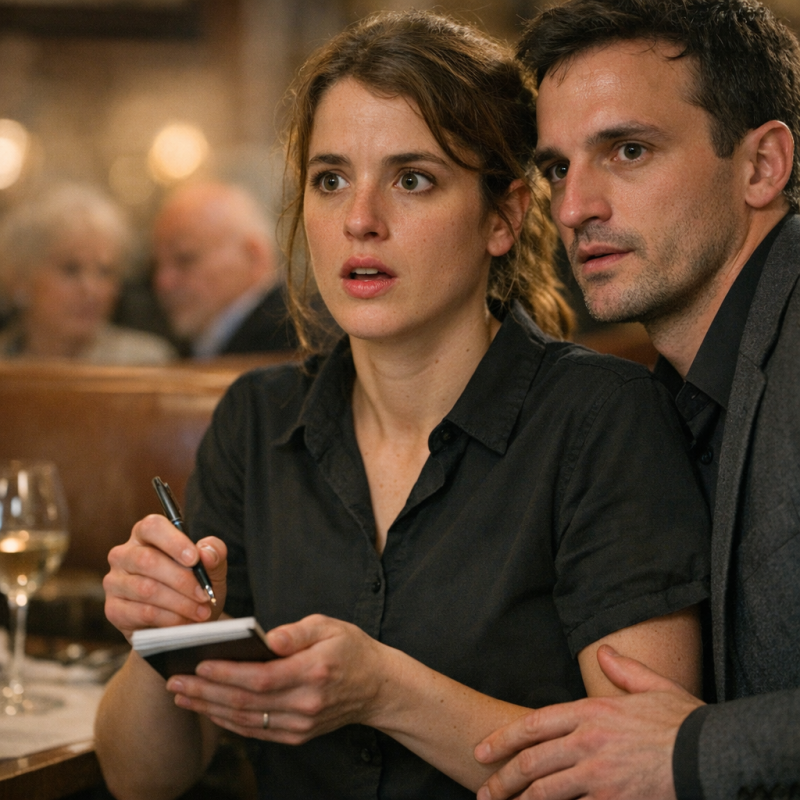 Image by FCT AI
The Aftermath in the Kitchen
The kitchen was loud and hot like always, but I couldn't hear anything except the ringing in my ears. Tessa found me standing by the dish pit, staring at my order pad like it was written in a language I'd forgotten how to read. 'Maya, you okay?' she asked, touching my elbow. I tried to explain what happened, but the words came out wrong, jumbled. Brandon, one of the line cooks, stopped plating long enough to say he'd personally burn their steaks if they ever came back. It should've made me feel better, but I just felt hollow. Tessa kept looking at me with this concerned expression, like she was trying to work something out in her head. 'What?' I finally asked. She bit her lip. 'It's probably nothing, but...' She trailed off, then shook her head. 'What, Tessa?' She glanced toward the dining room, then back at me. 'You know what's weird? I think I've seen them before.'
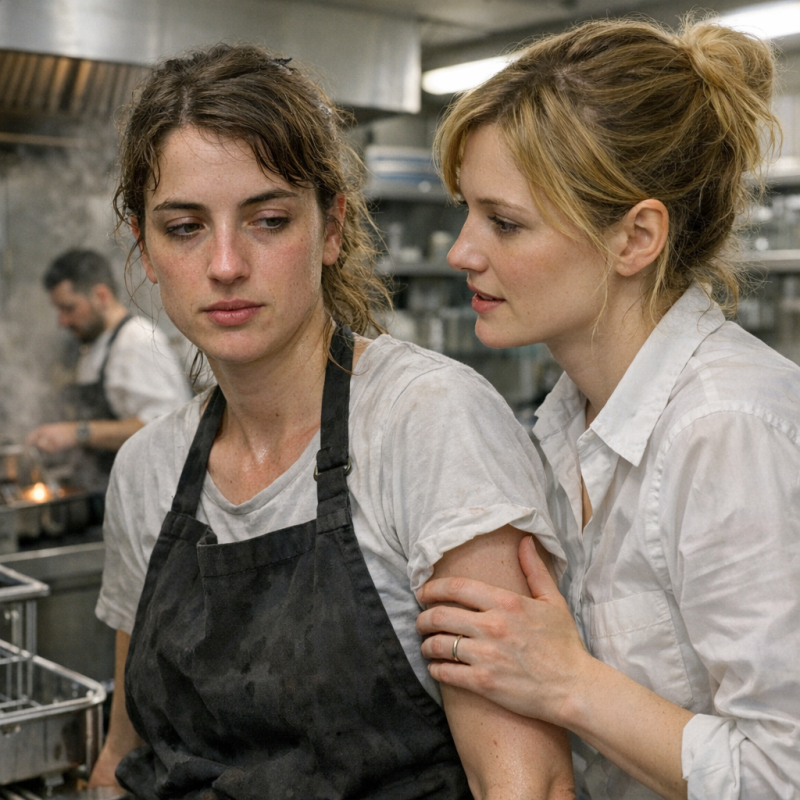 Image by FCT AI
Going Home With It
The rest of my shift felt like moving underwater. I smiled at customers, took orders, brought food, cleared plates, all while replaying those words in my head. 'You people.' The casual hatred in his voice. The way his wife had just sat there, silent and complicit. I kept catching myself mid-sentence with other tables, losing track of what I was saying. By closing time, I'd mis-rung two orders and forgotten to bring someone their salad dressing. Not my finest night. Brandon offered to walk me to my car, which was sweet but also made me feel pathetic. 'You sure you're good to drive?' he asked. I nodded, even though I wasn't sure of anything. The drive home was a blur of streetlights and that man's face. I couldn't shake the feeling that something about the whole interaction had been off, but I couldn't name what. My apartment building looked especially depressing in the dark, all peeling paint and flickering security lights. As I unlocked my apartment door, my phone buzzed with a text from Marcus: 'Can you come in early tomorrow? We need to talk.'
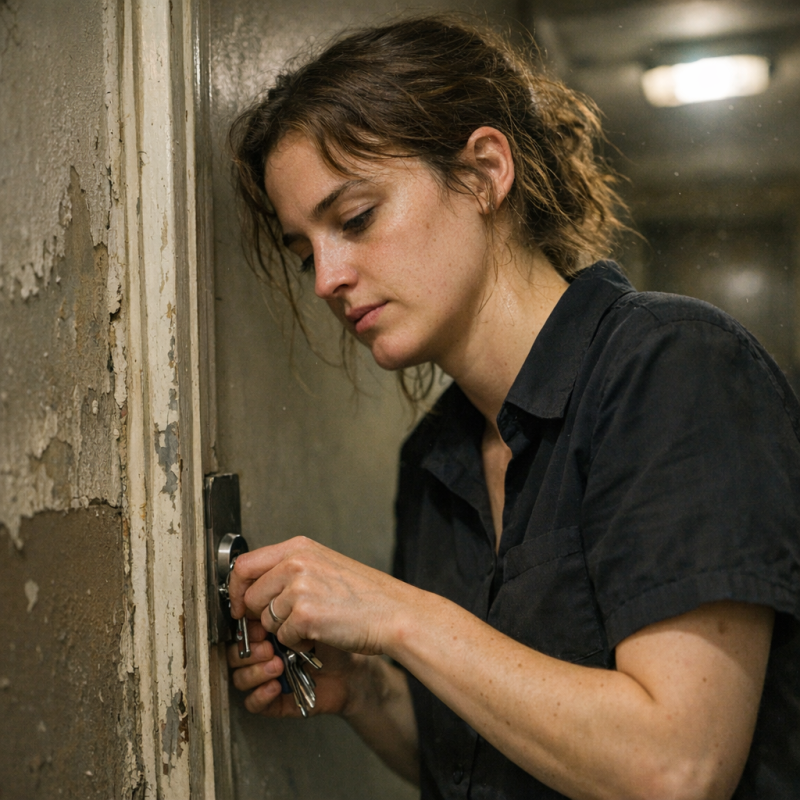 Image by FCT AI
The Morning After
I barely slept. Every time I closed my eyes, I saw that couple sitting at table twelve, the man's cold smile. I arrived at the restaurant forty minutes early, my stomach in knots. Marcus was already in his office, looking like he'd had about as much sleep as I had. 'Thanks for coming in,' he said, gesturing to the chair across from his desk. His voice had that careful, managed tone that managers use when something's really wrong. 'Is this about yesterday?' I asked. 'Because I didn't do anything—' 'I know,' he interrupted. 'Maya, I believe you. But we have a situation.' He pulled up something on his computer, clicked print, and I heard the printer whirring in the corner. The sound felt ominous, which is ridiculous—it's just a printer. But my heart was pounding anyway. Marcus took the printed page, looked at it for a second like he was dreading what came next, then slid it across the desk toward me. I saw the subject line: 'Formal Complaint - Discrimination.'
 Image by FCT AI
Reading the Accusations
I read it three times because it didn't make sense. According to their email, I had been the one who made discriminatory comments. Me. They claimed I'd been 'visibly hostile' from the moment I approached their table, that I'd made them feel 'unwelcome and targeted' because of their age, that I'd refused to serve them properly and had my manager 'forcibly remove' them when they'd politely asked for corporate's contact information. It was our interaction turned completely inside out. 'This is insane,' I said. Marcus nodded grimly. 'I know what I heard, Maya.' But doubt was already creeping in because that's what gaslighting does—it makes you question reality itself. I took a photo of the complaint and texted it to David, my partner. He called immediately. 'This is serious,' he said, his voice tight. 'Maya, this sounds like a lawsuit.' The word hung there between us. Lawsuit. My hands started shaking again. David works in insurance, so he knows about these things. 'This sounds like a lawsuit.'
 Image by FCT AI
Marcus's Assurance
Marcus must have seen the panic on my face because he quickly shifted into reassurance mode. 'Listen to me,' he said, leaning forward. 'The restaurant has your back completely. I was there. I heard what he said.' Relief flooded through me, so intense I almost started crying. 'We have surveillance footage of the whole thing,' he continued. 'The cameras cover every section. We'll send corporate the video, they'll see exactly what happened, and this whole thing will disappear.' I took a shaky breath. Evidence. Proof. The truth on camera. 'Really?' I asked. 'You're sure?' 'Positive,' Marcus said. 'I've already put in a request to pull the footage from that night. Once corporate sees it, this complaint is dead in the water.' For the first time since reading that email, I felt like maybe this would be okay. Maybe justice actually worked sometimes. Maybe the truth mattered. Just as I started to feel relief, Marcus's phone rang, and I watched his face go pale as he listened.
 Image by FCT AI
The Camera Problem
Marcus put the phone on speaker. It was Jeremy from corporate IT, calling about the footage request. 'So I pulled the files from last Tuesday,' Jeremy said. 'Good news and bad news. Good news: the video is clear, no problems there. Bad news: there was an audio malfunction with camera six that night. It's been happening on and off for a week—we've got a ticket in for it, but the recording has no sound.' My stomach dropped. Marcus asked him to repeat that. No audio. The video existed, but we couldn't hear anything that was said. 'The video quality is perfect,' Jeremy continued, oblivious to the disaster he was describing. 'You can see everything that happened. Just can't hear it.' Marcus thanked him and hung up. We sat there in silence. Without audio, what would the footage show? A server taking an order from a quiet, pleasant-looking older couple. Then a manager asking them to leave for no apparent reason. I realized that without audio, the footage would just show me talking to a quiet couple—and then the manager asking them to leave.
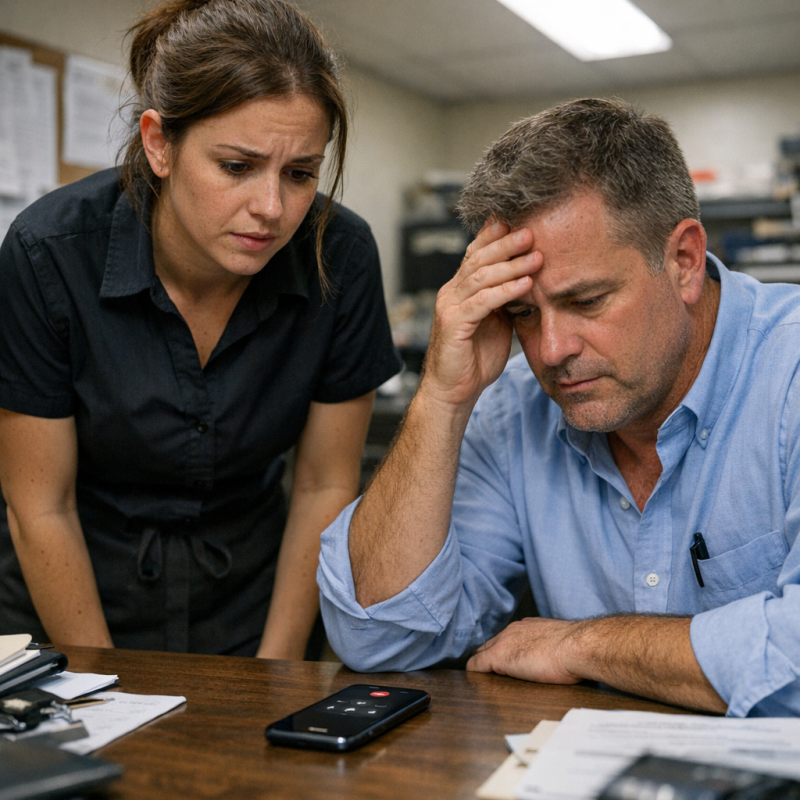 Image by FCT AI
Meeting the Owner
Carol called an emergency meeting that afternoon. She's owned the restaurant for fifteen years, and I'd always respected her no-nonsense approach to problems. But sitting across from her in that office, I felt like I was on trial. Marcus had already briefed her on everything. 'I've reviewed the complaint,' Carol said, her reading glasses perched on her nose. 'I've also reviewed the surveillance footage, such as it is.' She looked between Marcus and me. 'Marcus, you're certain about what you heard?' 'Absolutely,' he said firmly. Carol nodded, but I could see her doing calculations in her head. Restaurant math. Risk assessment. The corporate chain we were part of had deep pockets, which made us a target. 'The problem,' Carol said slowly, 'is that their version of events is documented in writing. Our version is two employees' word against theirs.' She wasn't hostile, just practical. Businesslike. But it felt like an interrogation anyway. Carol looked directly at me and asked, 'Maya, did you say anything that could be construed as offensive?'
 Image by FCT AI
Defending My Truth
I walked Carol through everything. Every single word I could remember from that interaction. The steak question. The wine comment. The way I'd smiled and nodded. The more I talked, the more I could hear how it sounded—like nothing. Like the most ordinary transaction in the world. Their written complaint, meanwhile, painted me as some kind of monster. I told her about the tension I'd felt, the way they'd watched me, but those weren't facts. Those were just feelings. Marcus backed me up on what he'd witnessed, which helped. Carol listened without interrupting, her expression unreadable. When I finished, I felt like I'd just given testimony in court. Like I'd laid out my entire defense and it still wasn't enough. She took off her reading glasses and rubbed the bridge of her nose. I waited. Marcus waited. The office felt too small. Carol was silent for a long moment, then said, 'I believe you. But that might not be enough.'
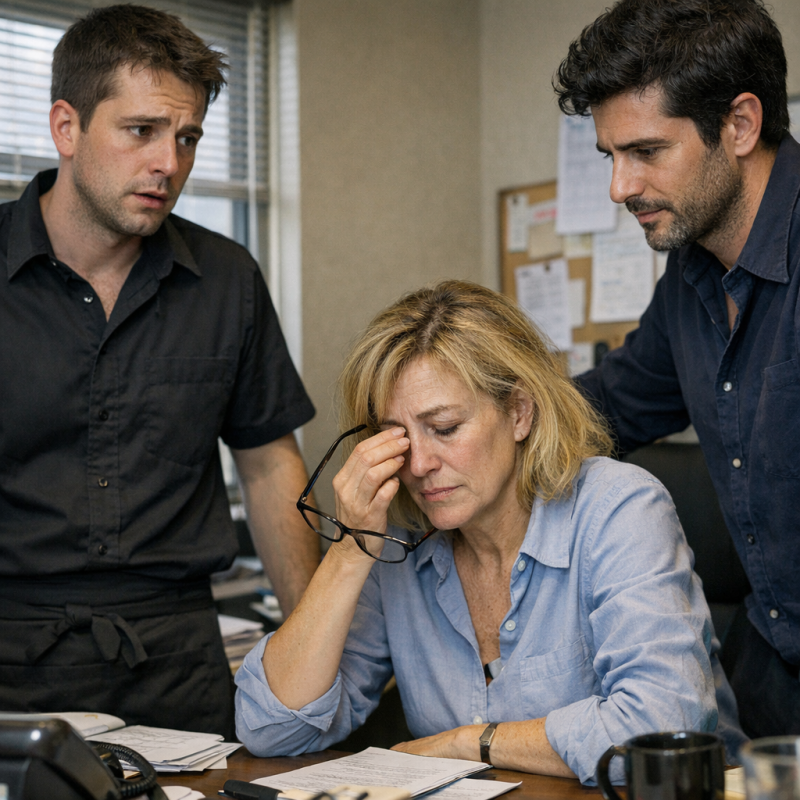 Image by FCT AI
Tessa's Memory
Tessa found me in the break room later that shift. I was staring at my phone, trying not to spiral. She sat down across from me and didn't say anything for a moment. Then: 'I heard about the complaint. That's such bullshit.' I appreciated the solidarity, but what could anyone really do? She leaned forward, her eyes narrowing like she was trying to remember something. 'Maya, I think I've seen them before. That couple. The description Marcus gave matches.' My heart did a weird little jump. 'Where?' I asked. She bit her lip, thinking. 'At my old job. The Italian place on Fifth. Like, a year ago maybe? They came in a few times.' I tried to keep my voice steady. 'Did anything happen?' Tessa's frown deepened. She looked troubled, like the memory was just out of reach but wrong somehow. When I asked where, Tessa frowned and said, 'At my old job. And I'm pretty sure they complained there too.'
 Image by FCT AI
The Old Restaurant
We stayed in that break room, both of us trying to piece together Tessa's memory. She couldn't remember specifics—just that the couple had been difficult. Particular. The kind of customers who made servers tense up. 'Did they complain about discrimination?' I asked. Tessa shook her head. 'I don't know. I wasn't their server. But there was some kind of thing. Drama. I just remember everyone talking about it.' My mind was racing. If they'd done this before, if they had a history of complaining, maybe that could help my case. Maybe it proved something. But what, exactly? That some customers are just difficult? That didn't change anything about my situation. Tessa was quiet for a minute, her face scrunched up in concentration. Then something clicked. Her eyes went wide. Tessa suddenly grabbed my arm: 'Wait. That place got sued. And the server got fired.'
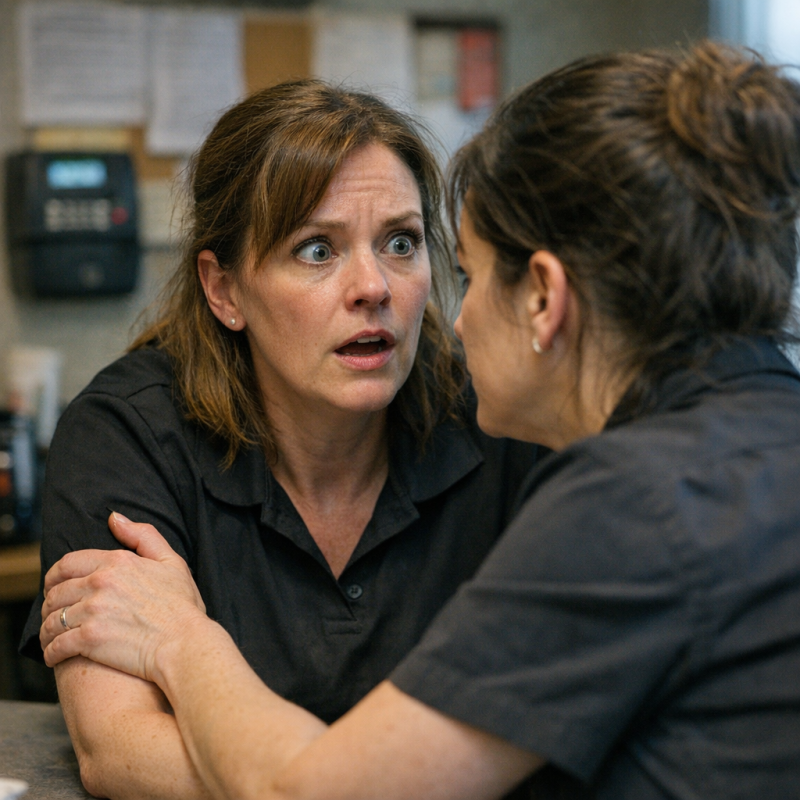 Image by FCT AI
Reaching Out
I needed more information. If the same thing had happened at Tessa's old restaurant, I needed to know how it went down. What happened to that server. Whether it was really the same couple. Tessa gave me the name of a coworker from that job—Jamie, someone who'd been there longer and might remember details. I hesitated before calling. Part of me didn't want to know. But I couldn't just sit around waiting for my own job to implode. Tessa stood beside me while I dialed, her arms crossed. The phone felt heavy in my hand. My throat was tight. This felt insane, like I was building a conspiracy theory out of nothing. But what if it wasn't nothing? What if there was something to this? I hit call. The phone rang four times before a tired voice answered, 'If you're calling about Richard and Helen, you're too late.'
 Image by FCT AI
The Server Who Lost Everything
Jamie knew their names. Not 'that couple' or 'those customers.' Their actual names. That alone sent chills down my spine. I explained who I was, what had happened at my restaurant. Jamie let out a long, bitter laugh. 'Yeah. That sounds about right.' They told me the story—an interaction almost identical to mine. A casual comment, twisted into something offensive. A written complaint. An investigation. Jamie had been with that restaurant for three years, spotless record, and they still got terminated. 'The owners didn't want the liability,' Jamie said. 'It was easier to just cut me loose.' I asked if the couple had a history of this. Jamie paused. 'I can't prove anything. But yeah, I think so. They knew exactly what to say, how to escalate things. It felt rehearsed.' My stomach turned. This wasn't just bad luck. This was something else. Jamie's voice cracked: 'They're really good at this. And you won't believe me until it's already over.'
 Image by FCT AI
Bringing It to Marcus
I went straight to Marcus with Jamie's story. I thought it would help—proof that this couple had done this before, that I wasn't just some careless server who'd messed up. Marcus listened carefully, taking notes. His face was sympathetic, which I appreciated. But when I finished, he set down his pen and sighed. 'Maya, I believe that this happened to Jamie. I really do. But we can't prove it's the same people. We don't have photos, no documentation. Just two similar stories.' I stared at him. 'But their names—' 'Are common names,' Marcus said gently. 'Richard and Helen could be anyone. Without concrete proof, this just makes you look...' He trailed off. 'Paranoid,' I finished for him. He didn't deny it. The truth was right there, and it didn't matter. Marcus listened carefully, then said, 'Without proof they're the same people, this just makes you look paranoid.'
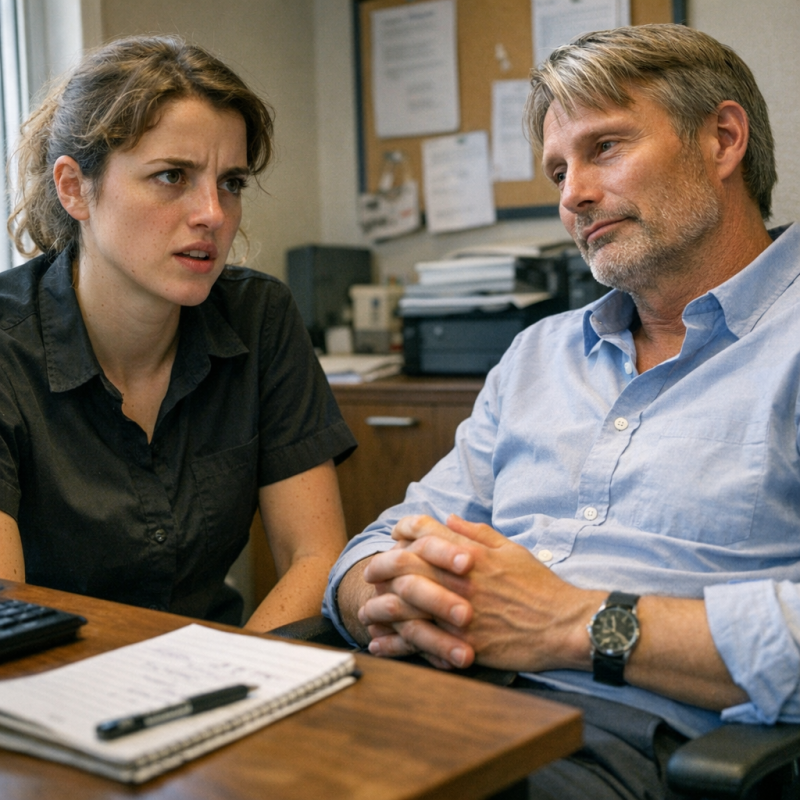 Image by FCT AI
David's Research
David saw how rattled I was when I got home. I told him everything—Tessa's memory, Jamie's story, Marcus's response. He got that determined look he gets when he's solving a problem. 'There has to be something online,' he said, opening his laptop. I didn't have much hope. What were the odds someone had documented this? But David started searching anyway. 'Serial restaurant complainers,' 'couple suing restaurants,' 'professional complaint scam.' I sat beside him, watching search results scroll past. Most of it was garbage—Reddit threads about difficult customers, news articles about legitimate discrimination cases. Nothing that matched. Then David clicked on a restaurant worker forum I'd never heard of. He scrolled through posts, squinting at the screen. His scrolling stopped. His whole body went still. He turned his laptop toward me, showing a forum post from two years ago: 'Has anyone else dealt with an older couple who...?'
 Image by FCT AI
The Forum Rabbit Hole
We fell down the rabbit hole. Post after post, different usernames, different cities, but the same story. An older couple. Polite at first. A complaint about discrimination. Written documentation. Threats of lawsuits. David kept clicking, and I kept reading, my anger building with each new account. These were real people, real servers, describing experiences almost identical to mine. Some had lost their jobs. Some said their restaurants had settled. The couple's names varied in the posts—sometimes Richard and Helen, sometimes other names, sometimes no names at all. But the pattern was there. You could see it if you looked. 'This is them,' I said. 'It has to be.' David nodded, his jaw tight. He clicked on one more post, dated eighteen months ago. I read it twice, my hands shaking. One post ended with: 'We settled out of court. They knew exactly what they were doing.'
 Image by FCT AI
Carol's Dismissal
I printed everything. Every forum post, every comment, every detail I could find about Richard and Helen's pattern. My hands were still shaking when I walked into Carol's office the next morning, Marcus already there, both of them looking like they'd aged five years overnight. I spread the pages across her desk like I was presenting a winning case. 'Look at this,' I said. 'It's the same couple. Different cities, same playbook. They've done this before.' Carol read slowly, her expression unreadable. Marcus leaned over her shoulder, his jaw tight. I waited for the relief, the validation, the moment when someone would finally believe me. Instead, Carol started shaking her head halfway through the second page. 'Maya,' she said carefully, 'I understand why you found this. I do. But anonymous internet posts... any lawyer will tear these apart in five seconds.' 'But it's a pattern,' I insisted. 'You can see it.' 'I can see it,' she said. 'But a court won't. Not like this.' Carol closed her laptop and said, 'Anonymous internet posts won't hold up. We need something real.'
 Image by FCT AI
The Lawyer's Letter
The letter arrived three days later. FedEx, signature required, the kind of envelope that makes your stomach drop before you even open it. Carol called me into her office. Marcus was already there, both of them looking at the pages like they were contaminated. The letterhead was expensive—some law firm in the city with three names that all sounded like trust funds. I sat down and Carol slid it across the desk. My eyes caught on phrases: 'discriminatory conduct,' 'emotional distress,' 'hostile environment,' 'willful negligence.' They were suing the restaurant. They were suing Carol personally. And they were naming me specifically as the primary actor in their discrimination claim. The language was cold, clinical, devastating. Each paragraph built on the last, turning my attempt to protect myself into evidence of malicious intent. I felt sick reading it. The couple claimed I'd targeted them from the moment they walked in, that I'd deliberately provided substandard service, that I'd created a hostile environment based on their age. None of it was true, but it was all there in legal language that made it sound credible. The letter listed damages in six figures and included a deadline: fourteen days to respond.
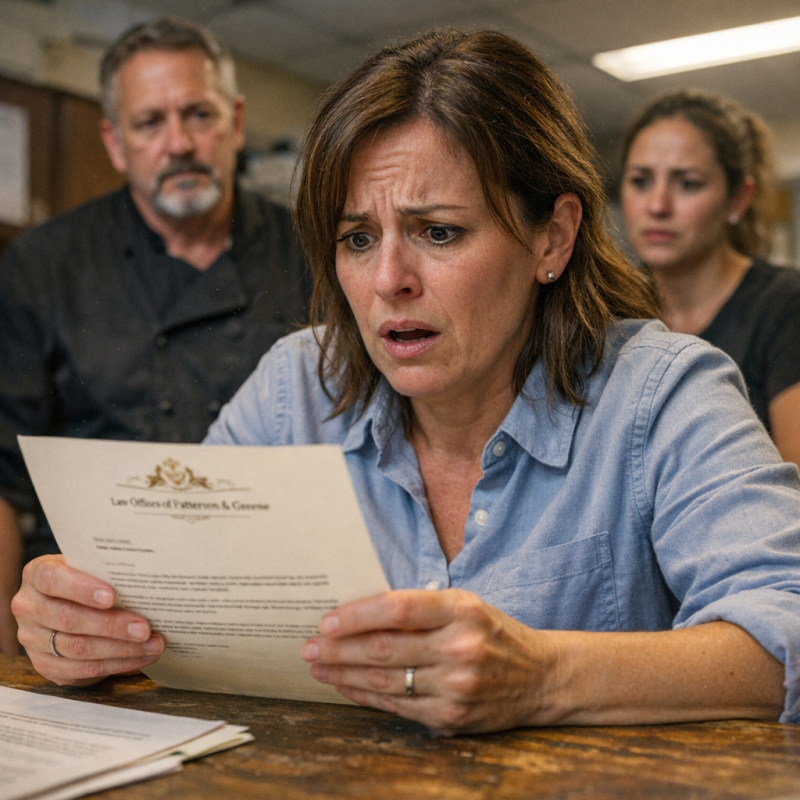 Image by FCT AI
The Restaurant's Lawyer
Carol's lawyer looked exactly like you'd expect—expensive suit, leather briefcase, the kind of tired eyes that had seen too many cases like this. His name was Robert, and he sat in Carol's office reviewing the letter while Marcus and I waited. I kept thinking he'd find the hole in their case, the obvious lie that would make it all fall apart. Instead, he just kept reading, occasionally making notes on a yellow legal pad. Finally, he looked up. 'The documentation is thorough,' he said. 'They have photos of the food, time stamps, written notes from the evening. And this forum post from the wife adds a personal element that will resonate with a jury.' 'But it's not true,' I said. My voice came out smaller than I intended. 'It doesn't matter if it's true,' Robert said, not unkindly. 'It matters what we can prove. And right now, they have documentation. You have your word.' He explained the risks: a jury trial, the optics of a young server versus an older couple, the cost of litigation that could drag on for years. He used phrases like 'exposure' and 'liability' and 'risk mitigation.' The lawyer looked at me with something like pity and said, 'Cases like this usually settle. The optics are just too risky.'
 Image by FCT AI
What Settlement Means
Robert left, and the three of us sat in Carol's office in silence. Finally, Marcus asked the question I'd been too afraid to voice. 'What would a settlement look like?' Carol's face went tight. She opened a folder, pulled out notes Robert had left behind. 'Monetary damages,' she said. 'A nondisclosure agreement. And...' She stopped. I knew what came next before she said it. 'They'll want someone held accountable,' Carol continued. 'The letter specifically names Maya. Any settlement would likely require—' 'My termination,' I finished. The word hung there. Marcus swore under his breath. Carol looked down at her desk, and I realized with sudden clarity that she'd already made the decision. This wasn't a discussion. It was a notification. 'The restaurant can't absorb this kind of financial hit,' she said. 'If we go to trial and lose, we could lose everything. If we settle and you stay on, they'll claim we didn't take their complaint seriously.' 'So I'm the sacrifice,' I said. 'Maya—' 'Just say it.' Carol wouldn't meet my eyes when she said, 'It's not about what's right. It's about what we can afford.'
 Image by FCT AI
Tessa's Loyalty
I didn't tell anyone at first. I went through my shift in a fog, running food, refilling drinks, smiling at customers who had no idea my entire life was imploding. But Tessa noticed. She always noticed. She cornered me during a lull, pulled me into the break room where Brandon was grabbing a smoke break. 'What happened?' she demanded. I told them everything—the letter, the lawyer, the settlement that required my termination. Brandon's cigarette burned forgotten in his hand. Tessa's face went from shock to fury in about three seconds. 'That's bullshit,' she said. 'Complete bullshit. You didn't do anything wrong.' 'Doesn't matter,' I said. 'They have documentation. I have nothing.' 'You have us,' Brandon said quietly. Tessa was already pacing, her mind working. 'How many servers are working tonight? How many would walk if they fired you?' 'Don't,' I said. 'You'll lose your jobs too.' 'So what?' Tessa shot back. She grabbed her phone, started texting. Within ten minutes, the break room was packed. Every server, two line cooks, even the dishwasher. Tessa slammed her hand on the break room table: 'If they fire you, we all walk.'
 Image by FCT AI
Searching for Jamie
That night, David and I made a plan. We needed more than forum posts and anonymous accounts. We needed someone who'd actually dealt with Richard and Helen, someone who could testify to their pattern. Jamie was the most recent victim we'd found, and her post had been detailed enough to include her city. It took me two days to track down a last name through cross-referencing posts, and another day to find an address that might be current. The drive took three hours. David came with me because there was no way I was doing this alone. The apartment building was rundown, the kind of place you end up when everything else has fallen apart. I climbed the stairs to the third floor, my heart pounding. The door to 3B was closed, a different name on the mailbox than I expected. I knocked anyway. A woman in her sixties answered, looked at me with suspicion. 'I'm looking for Jamie,' I said. 'Jamie Robinson. Does she still live here?' The woman's face softened slightly. 'Oh, honey. She moved out months ago. Broke her lease and everything.' When I finally reached Jamie's apartment, a neighbor said she'd moved out months ago—'Right after she lost that lawsuit.'
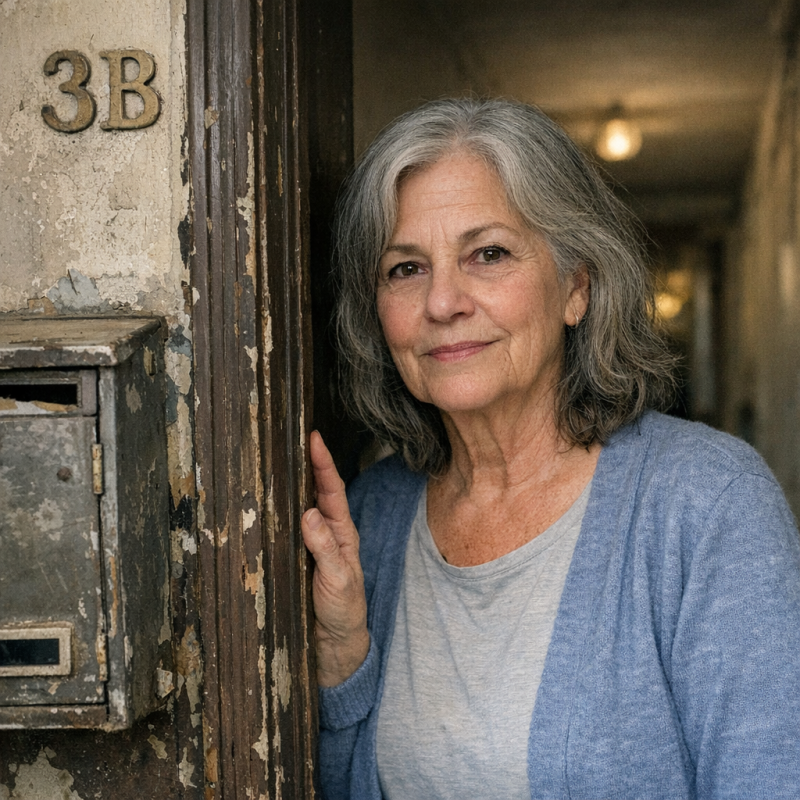 Image by FCT AI
The Forum Users
I created fake accounts that night. Not because I wanted to lie, but because I was starting to understand how dangerous the truth could be. I used a random name generator, a VPN David helped me set up, an email address that couldn't be traced back to me. Then I started messaging people who'd posted about Richard and Helen. The first few didn't respond. One account had been deleted entirely. But then someone replied—a username I recognized from the forums, someone who'd described an experience almost identical to mine. 'Are you really a server or are you one of them?' the message read. I explained my situation carefully, vaguely, trying to sound genuine without revealing too much. Their response came fast: 'Don't use your real name anywhere. They've sued people for defamation before. That's how they silence us.' My blood went cold. I thought about my Facebook post, my real name attached to every word. 'Defamation?' I typed back. 'Yes,' they replied. 'They claim you're damaging their reputation by talking about what they did. Even if it's true, they'll bury you in legal fees until you shut up.' The first reply came within an hour: 'Don't use your real name. They've sued people for defamation before.'
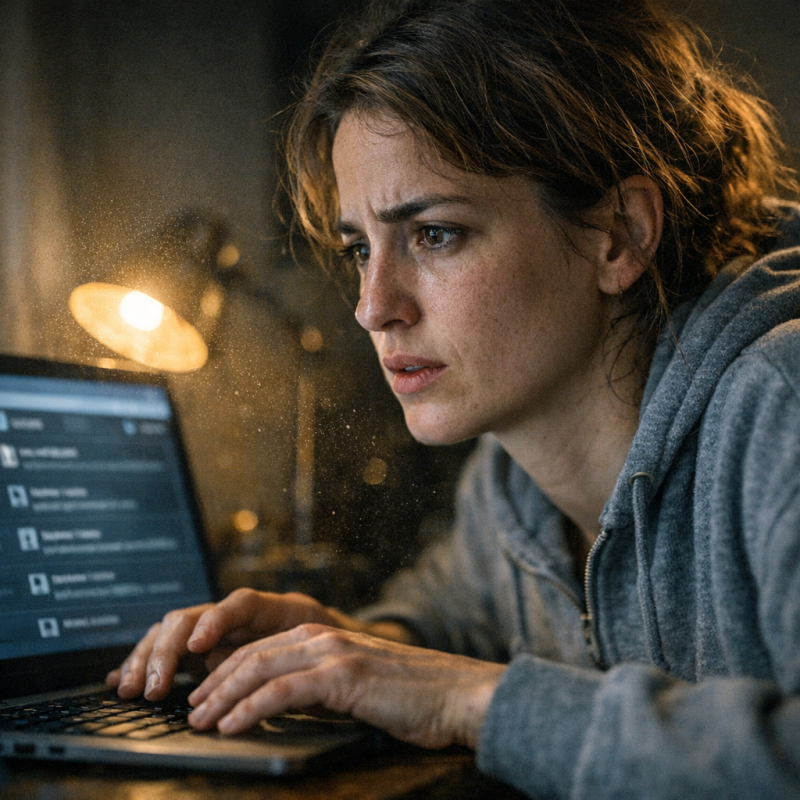 Image by FCT AI
Stories From Other Servers
The messages started coming in. Not all at once, but steadily over the next few days. Servers from different states, different restaurants, all with stories that made my skin crawl. They were careful, using anonymous accounts, never giving too many details. But the pattern was there, clear as day. An older couple. Always polite at first. A complaint about service or food quality. Documentation—photos, timestamps, written notes. Threats of discrimination lawsuits. Settlements or terminated employees. One server described how the husband had complained about wait times she could prove were normal. Another talked about the wife's 'notebook,' how she'd write in it constantly throughout the meal. A third mentioned the couple had claimed their food was cold when she'd literally just watched it come off the line. Reading the messages felt like staring into a mirror that reflected a dozen different versions of my own nightmare. They were comparing notes in my DMs, sharing details they'd been too afraid to post publicly. And then one message arrived that stopped me cold. I must have read it five times, my hands shaking harder each time. One message stood out: 'They always bring a notebook. The wife writes everything down. Everything.'
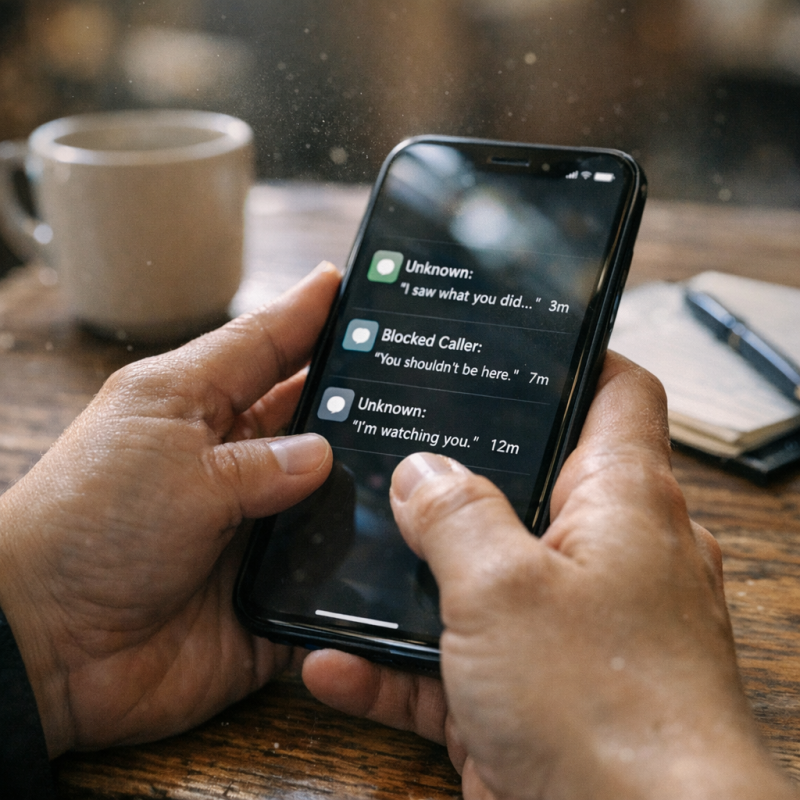 Image by FCT AI
The Notebook Detail
The moment I read that message about the notebook, something unlocked in my brain. A memory I'd completely buried. Helen had been writing during the encounter. I'd seen her do it. I'd watched her pull out this small, leather-bound notebook—the kind you'd use for recipes or grocery lists—and jot something down. It was right after I'd brought their drinks. At the time, I'd assumed she was making a note about something unrelated. Maybe a reminder to call someone, or an item to pick up at the store. People do that all the time at restaurants, right? But now, replaying the scene in my head, I could see it differently. She'd been watching me the entire time I approached their table. Her pen was already in her hand before I even said hello. And she'd written something the moment I walked away. Not quickly, like you do when you're trying to capture a fleeting thought. Deliberately. Methodically. Like she was documenting evidence. I'd thought she was just jotting down a reminder—but what if she was building a case from the moment they sat down?
 Image by FCT AI
Reviewing the Footage
Marcus called me on Friday afternoon. 'Corporate wants to review everything we have,' he said. 'Including the security footage. Can you come in?' I sat in his office watching the silent footage loop on his computer screen. No audio, just angles from three different cameras showing the dining room. I watched myself approach their table. Saw Richard's posture shift. Saw Helen reach for that notebook. Marcus had to take a phone call, so I sat there alone, watching it over and over. That's when I started noticing things I'd completely missed during the actual encounter. The way Helen glanced up at the camera before writing. How Richard positioned himself at a specific angle to the lens. The deliberate pause before his face changed from neutral to upset. They weren't just reacting. They were staging. Performing. And they seemed to know exactly where every camera was pointed. I paused on a frame where Helen was looking directly at the camera—almost like she knew exactly where it was.
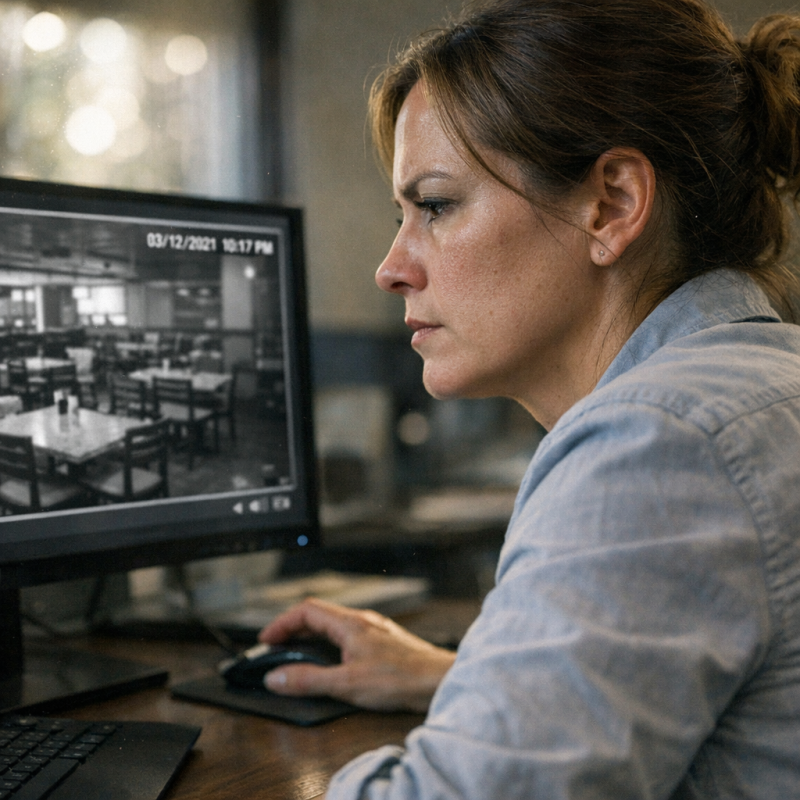 Image by FCT AI
The Body Language Expert
David has this friend from grad school, Simone, who teaches courses on nonverbal communication. She works with law enforcement sometimes, analyzing body language in interrogations and depositions. 'Let her watch the footage,' he suggested that night. 'Just see what she thinks.' I sent her the security video with no context, no explanation of what had happened. Just asked if she noticed anything unusual. She called me back two hours later. 'Can I come over?' she asked. 'I want to show you something.' She pulled up the footage on her laptop and started pointing things out. The micro-expressions. The performative gestures. The way Helen's distress appeared and disappeared like someone flipping a switch. 'Watch her hands here,' Simone said, rewinding. 'That's not anxiety. That's controlled behavior. See how she touches her neck? That reads as discomfort, but look at her eyes. She's checking the camera placement.' Simone played it through one more time, then sat back. After watching twice, she said, 'This woman isn't uncomfortable. She's performing discomfort.'
 Image by FCT AI
Carol's Breaking Point
Carol asked me to come in before the lunch shift on Monday. I knew what was coming. Her office felt smaller than usual. She looked like she hadn't slept. 'I've been going over the numbers with our lawyers,' she started. 'If we fight this in court, even if we win—which isn't guaranteed—the legal fees alone would be devastating.' She pulled out a folder. I could see documents inside. 'Their attorney is pushing for a settlement. It's less than they initially demanded, but still substantial. And they want...' She couldn't look at me. 'They want you terminated as part of the agreement.' I felt everything inside me go cold. 'I've looked at every option, Maya. I've talked to three different lawyers. They all say the same thing. The cost of litigation, the risk of losing, the potential damages—we can't survive it. The restaurant can't.' She opened the folder fully. She slid a severance package across her desk: 'I'm sorry, Maya. I really am.'
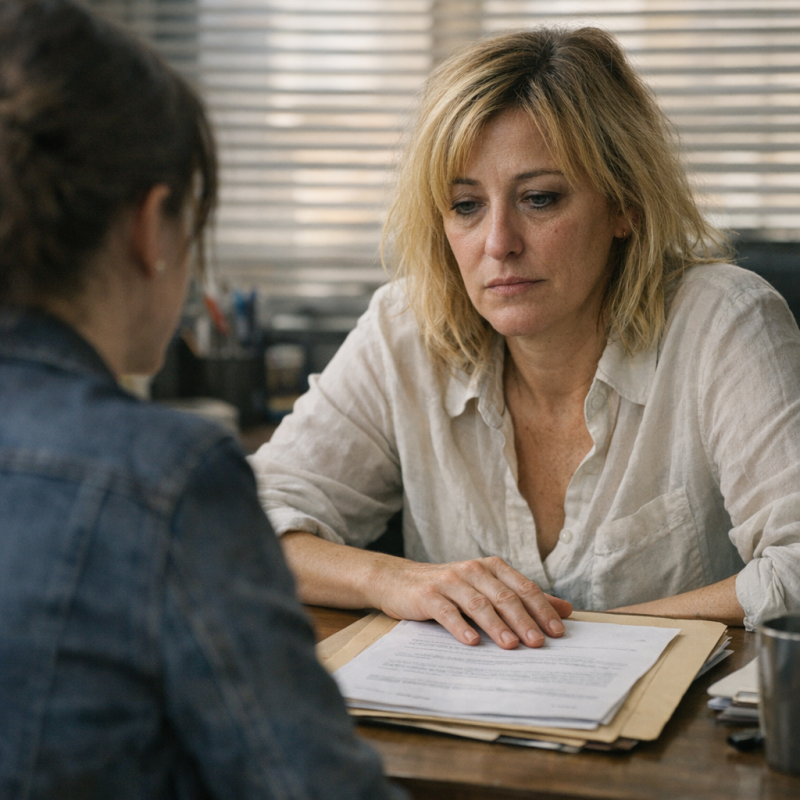 Image by FCT AI
The Walkout
Tessa called an emergency meeting in the parking lot before the dinner shift. Everyone showed up—every single server, most of the kitchen staff, even some of the bussers. 'This is garbage,' she announced. 'Maya did nothing wrong, and we all know it. If Carol fires her, we walk. Tonight.' I tried to talk them out of it. Told them they'd lose their jobs too. But Brandon cut me off: 'Let them fire all of us then. Let's see how they run a Friday dinner rush with no staff.' Five-thirty came. The dinner shift started. And the entire front-of-house staff walked out the door. I stood in the parking lot, watching through the windows as customers started arriving. Marcus was frantically trying to seat people himself. Carol emerged from her office, her face pale. The hostess stand was abandoned. Tables were filling up. No one was taking orders. It was chaos. And then Carol's phone rang. She looked at the screen, and I saw her whole body tense. As the dinner rush started and the restaurant stood empty of staff, Carol's phone rang—it was corporate.
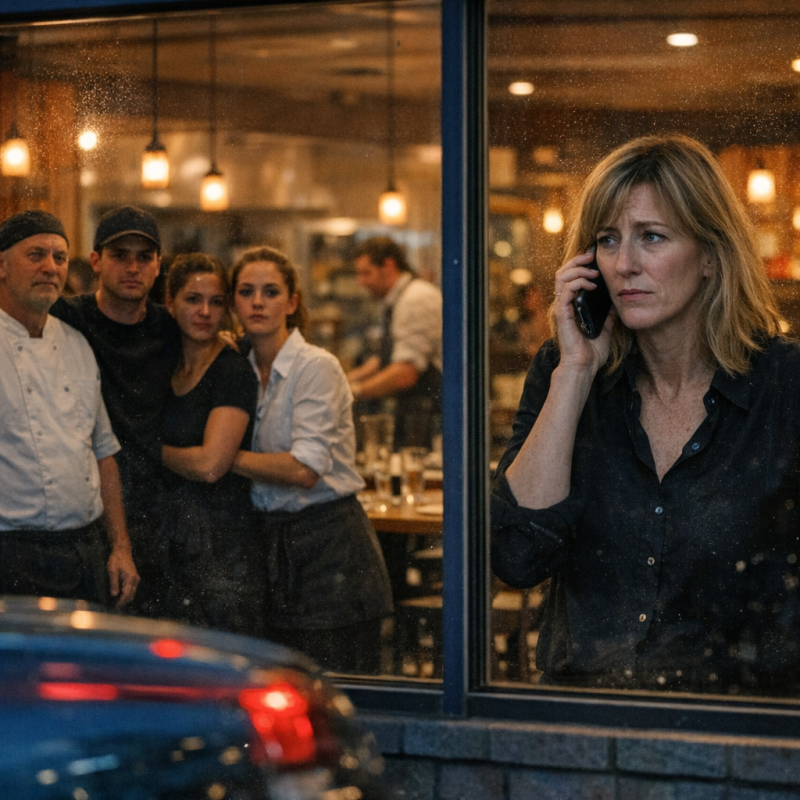 Image by FCT AI
Going Viral
Brandon had been documenting everything since the beginning. Every conversation, every meeting, every development. That night, after the walkout, he put it all together in a post. He didn't ask permission. Just wrote out the whole story—what had happened, how I'd been fired, why the staff had walked out—and posted it to his social media. He tagged restaurant worker advocacy accounts, local news pages, service industry groups. Then he shared it everywhere. I woke up Saturday morning to hundreds of notifications. The post had been shared thousands of times. People were commenting, sharing their own stories, expressing outrage. Someone had created a hashtag. Someone else had started a petition. By noon, local news outlets were reaching out for interviews. David showed me his phone. 'Look at Twitter,' he said. The story was spreading beyond just restaurant workers now. Food bloggers were picking it up. Labor activists. Even a few minor celebrities had weighed in. Within twelve hours, the hashtag was trending—and Richard and Helen's names were all over it.
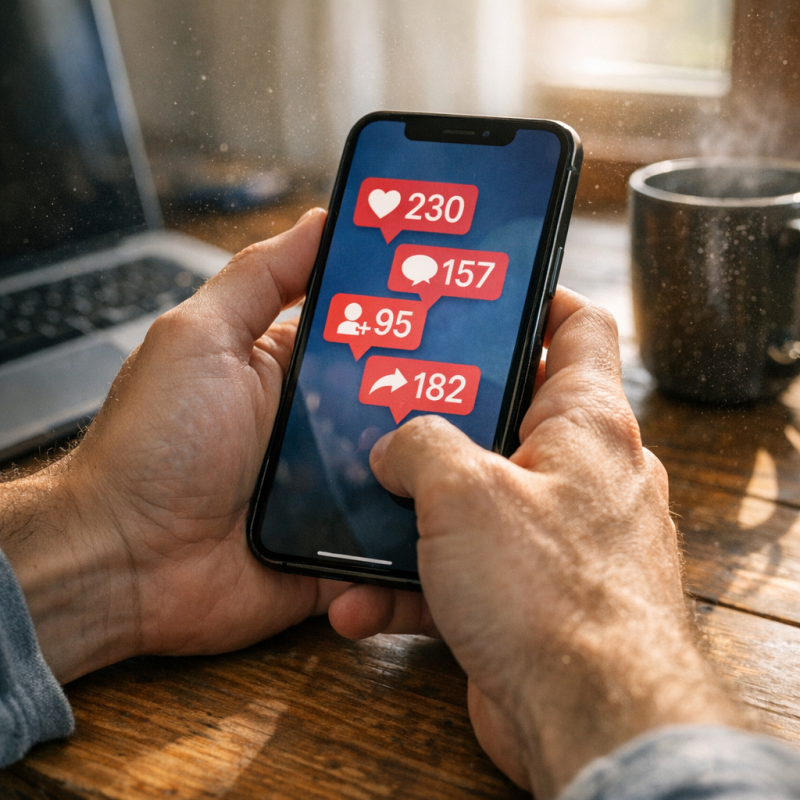 Image by FCT AI
The Backlash
The cease-and-desist letters arrived via email Monday morning. Professionally formatted, full of legal language, threatening defamation lawsuits against anyone who continued to 'spread false and damaging statements' about Richard and Helen. The email to me was eight pages long. It demanded I immediately retract any statements I'd made, delete any social media posts, and cease all communication about the incident. It threatened financial damages. It cited specific laws. It was designed to terrify. And it worked. But I wasn't the only one who got it. Tessa called me, her voice shaking. She'd received one too. So had Brandon. So had people who'd just shared the post, who'd left supportive comments, who'd done nothing but say they believed my story. They were going after everyone. Trying to silence anyone who dared speak up. David read through my letter carefully, his jaw tight. 'This is intimidation,' he said. 'Pure intimidation.' The letter arrived for me, for Tessa, for Brandon—even for people who'd just shared the post.
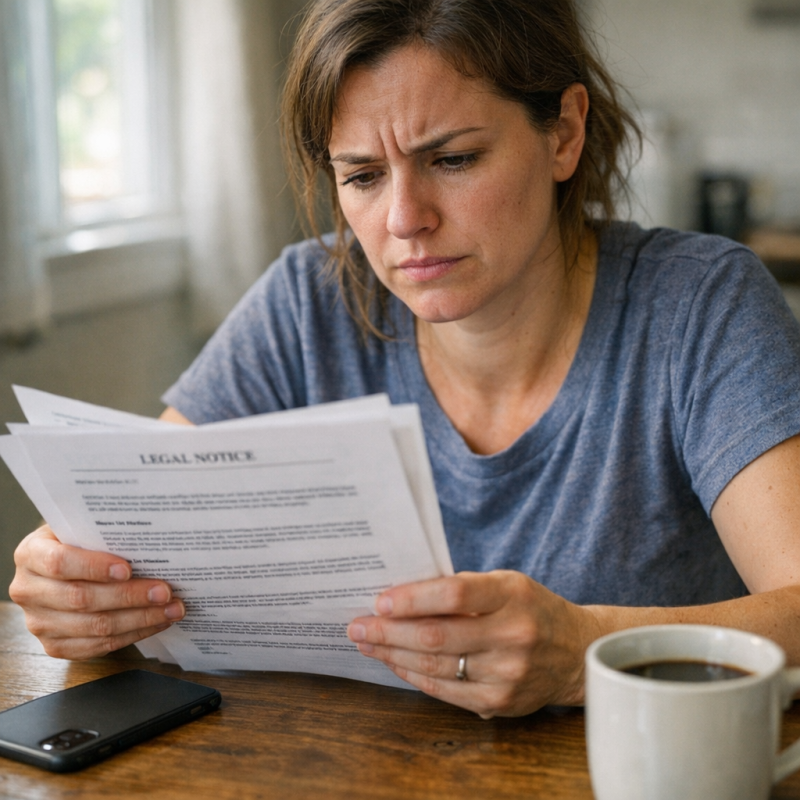 Image by FCT AI
Corporate Sends an Investigator
Jerome arrived on Wednesday. Corporate had sent him to 'assess the situation and minimize liability exposure,' according to Carol. He was maybe forty-five, methodical, asked precise questions. He interviewed Carol first, then Marcus, then asked to speak with me. I brought everything I had. The security footage. Screenshots of the messages from other servers. Simone's analysis. The cease-and-desist letters. I spread it all out on Carol's desk, expecting him to look overwhelmed or dismissive. Instead, he went very still. He picked up one of the printed messages from another server, read it carefully, then looked at the footage. He watched it twice without saying anything. Then he pulled out his own folder. 'How many locations has your chain dealt with similar complaints?' I asked. He opened the folder. It was thick with documented incidents. 'Seventeen,' he said quietly. 'In the last three years. Always the same pattern. Always settled quietly.' He looked at me directly. Jerome looked at the evidence I'd gathered and said something unexpected: 'I've seen this before.'
 Image by FCT AI
Jerome's Files
Jerome spread the folder contents across Carol's desk. There were incident reports from restaurants in Ohio, Pennsylvania, Virginia, North Carolina, Tennessee. Each one followed the same structure: complaint filed, server terminated or resigned, settlement offer within three weeks. The amounts varied—three thousand here, five thousand there, once twelve thousand for what the notes described as 'particularly inflammatory social media response.' Marcus stood in the doorway, his face gray. He'd been so sure this was a one-time problem. Carol kept shaking her head, picking up different reports and reading them. 'How did no one connect these?' she asked. Jerome's expression was carefully neutral. 'Different locations, different franchisees, different legal teams handling settlements. Corporate saw the pattern about two years ago, but the decision was made to handle each case individually.' I felt something cold settle in my chest. They'd known. The whole time Richard and Helen were destroying my life, someone in a corporate office somewhere knew this had happened before. He opened a file folder two inches thick: 'Sixteen restaurants in five years. Always the same pattern.'
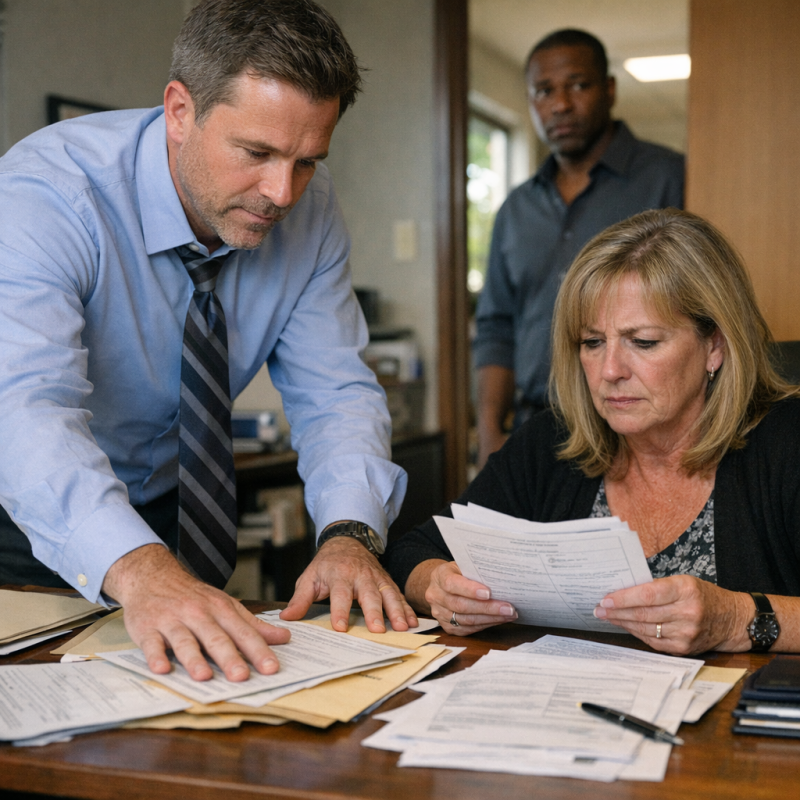 Image by FCT AI
Why Corporate Stayed Silent
Jerome explained it methodically, like he was presenting quarterly earnings. Corporate had run the numbers. Fighting each case would mean legal fees, media attention, potential discovery that could expose the pattern to more plaintiffs. Settling quietly cost less. Five thousand here, ten thousand there—it was cheaper than a prolonged legal battle. 'We projected they'd eventually age out of the behavior or move on to other targets,' he said. Carol looked like she might be sick. 'Other targets,' she repeated. 'You're talking about people. Employees.' Jerome didn't flinch. 'I'm explaining the institutional reasoning. I'm not defending it.' He'd been sent to assess whether *this* case was different, whether it had finally escalated beyond the point where quiet settlements would work. The answer was yes—because I'd documented everything, because I'd found the pattern myself, because I hadn't just accepted their money and disappeared. But knowing that corporate had let this happen, over and over, knowing they'd chosen the cheaper option while people's careers burned—I stared at him in disbelief: 'You knew they were doing this, and you just let them keep destroying people's lives?'
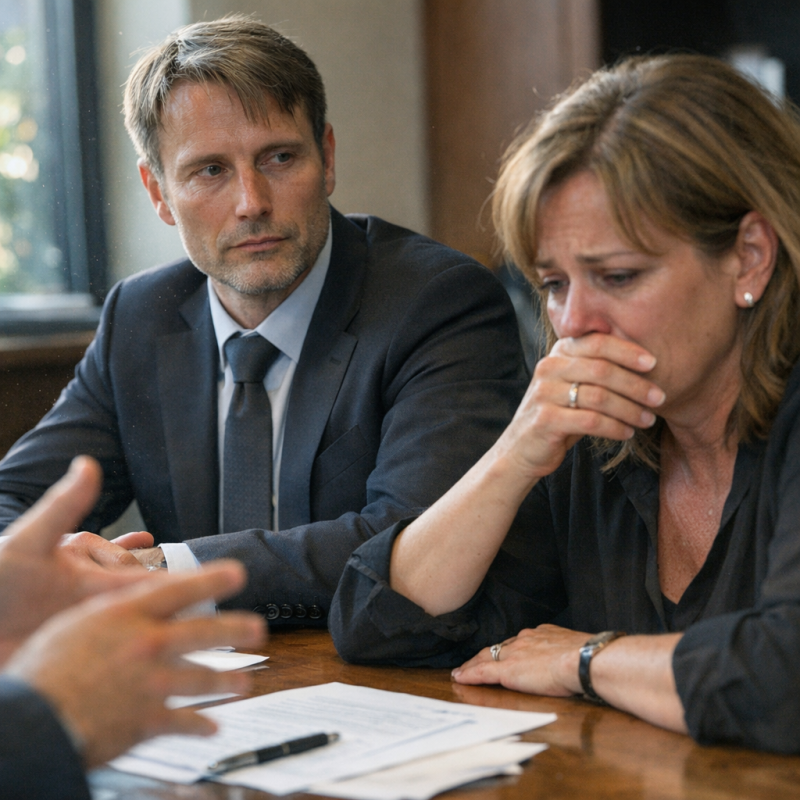 Image by FCT AI
Meeting HR
Lisa arrived the next day, flying in from Chicago. She was younger than Jerome, maybe early thirties, with the kind of professional warmth that felt practiced. She set up in Carol's office with her laptop and a leather portfolio. 'I want to start by saying we take these allegations very seriously,' she began. I almost laughed. Jerome at least had the decency to be direct about corporate's failures. Lisa was all strategic phrasing and damage control. She talked about 'potential pathways to resolution' and 'protecting all parties involved.' What she meant was: how much money would make me go away quietly. When I showed her the network I'd built—the other servers, the forum posts, the evidence Simone had compiled—her expression shifted. Not worried, exactly. Calculating. She asked about media contact, whether I'd spoken to any journalists. I hadn't, but I didn't tell her that. 'We want to handle this correctly,' she said carefully. 'We're prepared to consider more comprehensive action this time.' I asked the obvious question: would they actually fight Richard and Helen, or just throw money at another settlement? She looked uncomfortable when I asked if they'd fight this time: 'That depends on how much noise you're willing to make.'
 Image by FCT AI
The Other Victims
Jerome did one thing right: he connected me with the others. Three of them agreed to talk—servers from restaurants in different states who'd been through the same nightmare. We set up a video call. There was Amanda from North Carolina, who'd been accused of spitting in Helen's tea. Trevor from Ohio, who'd supposedly made racist comments Richard 'overheard.' And Kaitlyn from Virginia, whose story was so close to mine it was eerie: the steak, the complaint about her 'tone,' the social media campaign. We spent two hours comparing experiences. The timeline of escalation, always the same. The specific phrases in the complaints. The way Richard would create situations that forced you to interact while Helen documented everything. Trevor had saved screenshots too. Kaitlyn had security footage her manager had given her before he was pressured to delete it. We weren't crazy. We weren't making connections that didn't exist. This had happened, systematically, to all of us. The relief of being believed mixed with rage at how long it had taken to find each other. On the video call, one of them said what we were all thinking: 'What if we all came forward together?'
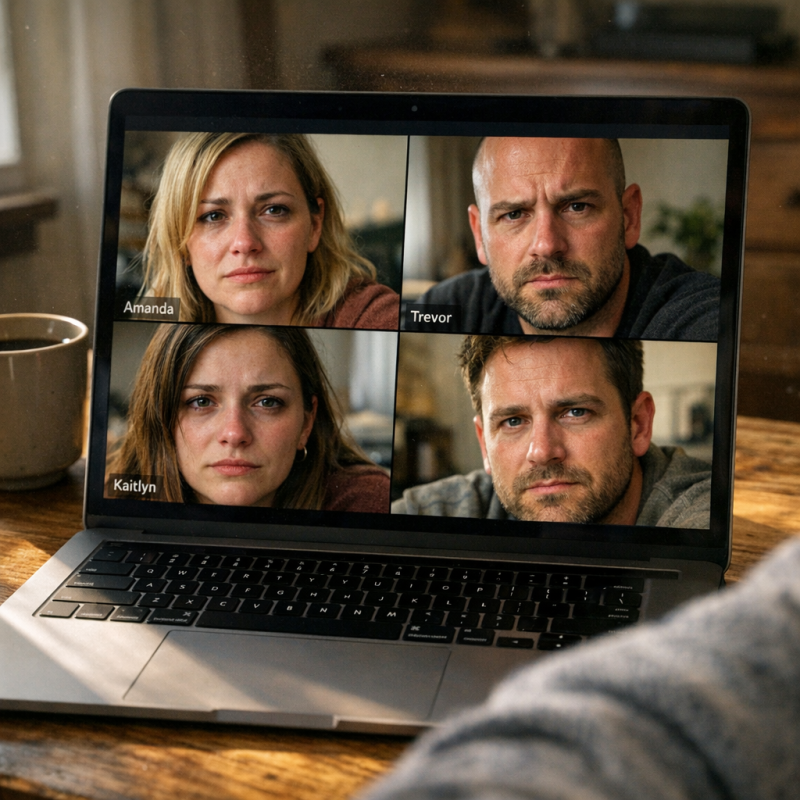 Image by FCT AI
Building the Case Together
We created a shared document. It started as a simple list: how the pattern always began, the escalation tactics, the specific complaints they filed. But as we added details, the similarities became impossible to dismiss. They always targeted newer servers, people who didn't have years of stellar reviews to fall back on. The complaints always included photo or video 'evidence' that looked damning without context. They always had a witness to corroborate—usually each other, sometimes a friend who happened to be dining with them. The legal threats always came exactly two weeks after the initial complaint. Always. I worked on it for hours that night, cross-referencing our experiences. David brought me tea and read over my shoulder, his hand tightening on my shoulder as the list grew longer. By midnight, we had forty-three exact matches in behavior, timing, and tactics. Forty-three things that were too specific to be coincidence. Trevor found forum posts from people we hadn't even contacted yet, describing the same pattern. This wasn't just multiple incidents. This was something else, something deliberate and practiced. We created a shared document listing every similarity—and by the end, we had forty-three exact matches.
 Image by FCT AI
The Lawyer Who Believes
Kaitlyn knew a lawyer. Not the employment attorney her restaurant had connected her with for the original settlement—someone different. A woman named Sarah Chen who'd made her name prosecuting fraud cases, the kind that involved complex schemes and multiple victims. 'She likes puzzles,' Kaitlyn said. 'And she hates people who game the system.' We sent her everything: the compiled evidence, the shared document, Jerome's files from corporate, every piece of the pattern we'd found. I didn't expect much. Lawyers cost money we didn't have, and even good ones might not see what we were seeing. But Sarah called back within three days. David was with me when I took the meeting. She'd printed out our entire submission—hundreds of pages—and color-coded it. 'Tell me if I'm understanding this correctly,' she said, walking us through her analysis. Same targets. Same tactics. Same timeline. Same outcomes. Multiple states, multiple years, same couple. I nodded, watching her process it. After reading everything, the lawyer leaned back and smiled: 'This isn't a discrimination case. It's a racketeering case.'
 Image by FCT AI
What Racketeering Means
Sarah explained it over another call with all four of us. Racketeering wasn't just organized crime in the traditional sense. It was any pattern of illegal activity conducted as part of an ongoing enterprise. If Richard and Helen had been systematically defrauding restaurants and individuals—filing false complaints with the intent to extort settlements—that could qualify under RICO statutes. 'The key word is *systematic*,' she said. 'We need to prove they knew what they were doing from the start. That it wasn't just a couple who complained a lot and happened to get settlements. That they planned it, repeated it, refined it.' The evidence we had showed the pattern. But proving intent meant finding something that showed they *knew* they were running a scheme. Something that showed premeditation, coordination, deliberate targeting. Trevor asked what that would look like. Sarah thought for a moment. 'Communications where they discuss strategy. Evidence they researched targets beforehand. Records showing they tracked settlements or planned their approach. Anything demonstrating consciousness of wrongdoing.' My stomach tightened. That was a high bar. She looked at each of us: 'But we need proof they knew exactly what they were doing from the start.'
 Image by FCT AI
The Paper Trail
We started with public records. Court filings, settlement agreements that hadn't been sealed, anything that left a paper trail. Amanda found three cases in North Carolina databases. Trevor found two in Ohio. I discovered that Pennsylvania requires certain settlement disclosures—that gave us two more. Kaitlyn tracked down a lawsuit that had been filed but withdrawn before trial, the kind of thing that only shows up if you know exactly where to look. By the end of the first week, we had nine documented settlements in public records. Nine times Richard and Helen had filed complaints, pushed for legal action, and walked away with money. The amounts added up fast: forty-seven thousand dollars across five years, just from the cases we could prove. But the forum posts suggested so much more. Stories from people who'd settled privately, signed NDAs, couldn't talk publicly but had left anonymous breadcrumbs online. Sarah helped us estimate based on corporate's pattern: probably twenty to twenty-five total cases, maybe more. We found nine settlements in public records—but the forum posts suggested there were at least twenty more that settled privately.
 Image by FCT AI
The Money
David spread all our documentation across the dining table. We'd been working in silence for an hour, double-checking every public record we'd found. I watched him add up the settlement amounts again, his calculator clicking in the quiet apartment. 'Just the confirmed cases,' he said, tapping his pen against the notebook. 'The ones we can actually prove from court records.' I nodded, waiting. We'd found nine settlements with specific dollar amounts listed in public filings. Nine times Richard and Helen had walked away with money. David wrote the total at the bottom of the page, then sat back. The number seemed impossible. 'Maya, this is over four hundred thousand dollars,' he said quietly. 'And that's just what we can document. The forum posts suggested at least twenty more cases that settled privately.' I stared at the number. Four hundred thousand. From complaints about restaurant service. From getting servers like me fired. This wasn't about feeling disrespected or demanding justice. This was about money. This was a business. When we added up just the cases we could confirm, the total came to over four hundred thousand dollars.
 Image by FCT AI
The Smoking Gun Search
The attorney was blunt during our next call. 'Everything you've found establishes pattern,' she said. 'But to prove fraud, we need evidence of intent. We need someone who witnessed them planning this. Someone who heard them rehearsing their act.' I felt my stomach drop. Rehearsing? That seemed like an impossible thing to find. David and I spent the next week searching. We combed through social media, looking for anyone who'd worked with them, lived near them, known them personally. We found nothing. Everyone they'd targeted were strangers—servers and managers who'd only met them once. That seemed deliberate now. Strategic. I started drafting messages to people in the forum, asking if anyone had ever overheard anything suspicious. Most didn't respond. The ones who did had nothing useful. I was sitting on the couch, ready to give up for the night, when my phone buzzed. A text from Tessa. Just a screenshot, no explanation. My heart started pounding before I even read it. I started to think we'd never find it—until Tessa texted me a screenshot from a neighborhood Facebook group.
 Image by FCT AI
The Neighbor's Post
The screenshot showed a post from someone named Jennifer Martinez in a Greensboro neighborhood group. The post was three months old, buried deep in the feed. Tessa had found it by searching 'restaurant' in the group's history. Jennifer had written: 'Does anyone else have neighbors who argue CONSTANTLY? The couple next door has been at it again, and I swear they're practicing some kind of restaurant complaint script. Keeps me up at night.' My hands were shaking as I read it. Script. She'd written the word script. Other neighbors had commented, mostly sympathizing about noise. But Jennifer had replied to one of them with more detail: 'I'm not even joking about the script thing. Last night I heard them debating which phrases sound more authentic. The husband said something about 'keeping it casual but pointed.' It's bizarre.' I called Tessa immediately. 'Where did you find this?' I asked. 'I've been searching Facebook groups near all their known addresses,' she said. 'Took me days, but I found her.' The post was three months old, but the neighbor had written: 'It's like they're practicing lines for a play about bad service.'
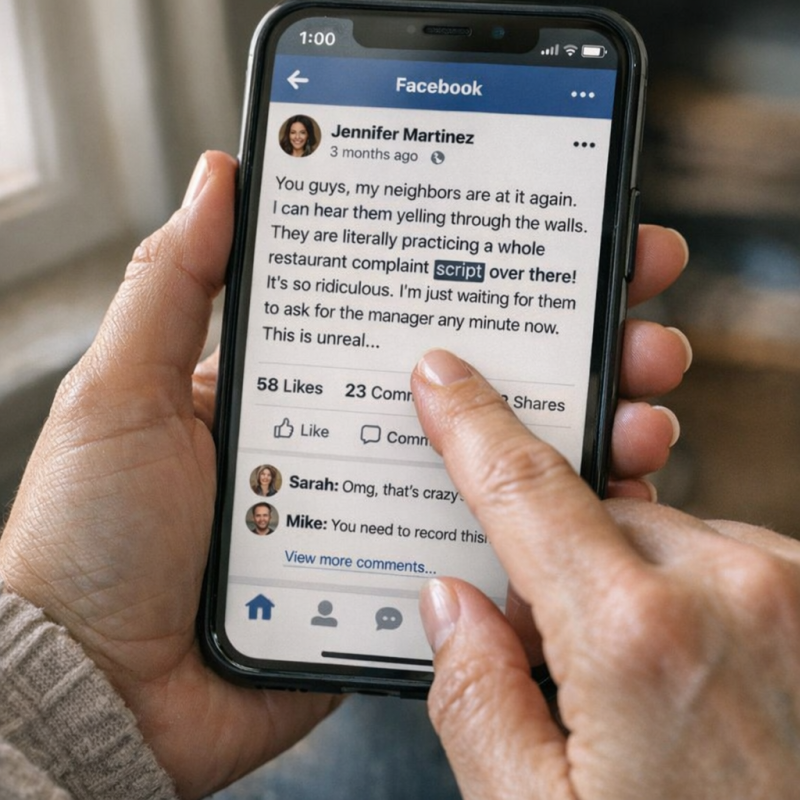 Image by FCT AI
Finding the Neighbor
Finding Jennifer Martinez's contact information took another day. David helped me craft a message that wouldn't sound completely insane. We explained who we were, what we were investigating, and asked if she'd be willing to talk. She responded within an hour: 'I've been wondering when someone would ask about them.' We drove to Greensboro the next morning. Jennifer lived in a tidy duplex with a shared wall. She was maybe fifty, with kind eyes and a no-nonsense demeanor. 'You're the server they targeted?' she asked when she opened the door. I nodded. She looked at David, then back at me. 'Good. Someone should finally do something about those two.' We sat in her living room, surrounded by family photos and plants. She brought us tea without asking if we wanted any. 'I've lived here four years,' she said, settling into her chair. 'They moved in about six months after me. At first I thought they just fought a lot. Marital problems, you know?' She paused, sipping her tea. 'But then I started noticing patterns.' She invited us in, made tea, and said calmly, 'Oh, the lawsuit couple? Yeah, I've heard them practicing for years.'
 Image by FCT AI
What the Neighbor Heard
Jennifer spoke carefully, like she'd been organizing these thoughts for a long time. 'The first time I really paid attention was maybe two years ago,' she said. 'I heard Richard—that's his name, right?—saying 'No, that's too aggressive. It needs to sound casual, like I'm just making conversation.' And Helen said something like 'What if I look uncomfortable here? Would that help?'' My stomach turned. David was taking notes. 'They'd go through scenarios,' Jennifer continued. 'Different restaurant situations. Different types of complaints. I heard them discussing which phrases got better responses. Which managers were more likely to panic. They talked about it like they were workshopping a performance.' She described hearing them celebrate after settlements. Champagne corks popping. Helen saying 'That was our best one yet.' Richard analyzing what had worked. 'I didn't understand what I was hearing at first,' Jennifer said. 'I thought maybe they were writers or something. Researching for a book?' Then she stood up and walked to a drawer. She pulled out a small notebook: 'I started writing it down when I realized it wasn't just marital bickering.'
 Image by FCT AI
The Attorney Reviews the Evidence
I sent the attorney photos of every page in Jennifer's notebook. Dates, times, specific phrases she'd overheard. Direct quotes from Richard and Helen about 'the restaurant approach' and 'settlement strategies.' The attorney called me back within two hours. 'This is extraordinary,' she said. Her voice had changed—sharper, more focused. 'This is exactly what we needed. A credible witness with contemporaneous documentation of premeditation.' She explained that Jennifer's notes, combined with the public settlement records, established a clear pattern of fraud. 'We can file for discovery now,' she said. 'Force them to turn over communications, financial records, all previous settlement agreements.' I could hear her typing. 'I'm drafting subpoenas for their bank records, phone records, and any documents related to restaurant complaints or settlements. If they've been doing this systematically, we'll prove it.' My heart was racing. This was really happening. We weren't just defending ourselves anymore. We were going on offense. 'How long?' I asked. 'Two weeks, maybe three,' she said. The attorney started drafting subpoenas: 'With this, we can force them to turn over all their settlement agreements.'
 Image by FCT AI
The Subpoena Response
Richard and Helen's attorney responded exactly ten days later with a motion to dismiss our counterclaim and seal all records. The filing was aggressive, calling our evidence 'speculative' and Jennifer's testimony 'hearsay from an unreliable witness.' They argued that their previous settlements were protected by confidentiality agreements and irrelevant to our case. The attorney called me that afternoon. 'They're scared,' she said simply. 'This is a Hail Mary attempt to keep their records hidden.' The hearing was scheduled for the following week. I couldn't attend—it was a procedural thing, lawyers only—but the attorney promised to call me immediately after. I spent that entire day barely able to focus on anything. David kept checking his phone for updates. Finally, at 3:47 PM, my phone rang. 'Maya?' the attorney said. I could hear the smile in her voice. 'We won. The judge called their motion 'without merit' and granted our discovery requests in full.' I actually gasped. 'What does that mean?' I asked. But the judge denied their motions—and ordered them to produce every settlement agreement from the past seven years.
 Image by FCT AI
The Documents Tell the Story
The documents arrived as a massive PDF file three weeks later. I opened it on my laptop with David sitting next to me. Page after page of settlement agreements, organized chronologically. The attorney had already reviewed everything, but she wanted me to see it myself. 'Start from the beginning,' she'd said. 'You need to understand what you were up against.' The first settlement was from 2016. A steakhouse in Ohio. The complaint described Richard making 'casual conversation' about politics. The server allegedly made a 'dismissive comment about conservative views.' Settlement: fifteen thousand dollars, server terminated. I kept reading. A bistro in Pennsylvania, 2017. Richard ordered his steak 'well-done but not burnt.' Complained it came back 'deliberately ruined.' Twenty-two thousand, server fired. Restaurant after restaurant. The same pattern, slightly different scripts. Helen was always there, always silent, always taking notes. Their attorney's letters used identical language. And then I found the spreadsheet, attached to a 2019 settlement. Richard had actually created a tracking document. Restaurant names, complaint types, settlement amounts, 'effectiveness ratings.' Twenty-nine restaurants. Forty-two individual servers fired. Over six hundred thousand dollars in settlements—and it was all documented, deliberate, and completely planned.
 Image by FCT AI
Reframing Everything
The attorney walked me through each settlement with this clinical precision that made my skin crawl. Every detail I'd experienced—the casual political comment, the specific steak order, Helen's silent note-taking—appeared in complaint after complaint, settlement after settlement. Different restaurants, different servers, same exact script. She showed me a settlement from 2018 where the server had described Richard making 'seemingly friendly conversation about news events' before 'deliberately provoking a political disagreement.' The language in his complaint matched mine almost word for word. 'See the pattern?' the attorney asked. 'He's been refining this for years.' The steak order was particularly calculated. Multiple servers had written about being asked to cook it 'well-done but not burnt,' then being accused of 'deliberate sabotage' when it came back slightly overcooked. Helen's note-taking appeared in every single incident report—witnesses described her as 'documenting everything' with 'unusual detail.' David sat beside me, his hand on my shoulder, as I read through case after case of people who'd been exactly where I was. Then the attorney pointed to one settlement from 2019. 'This server tried to fight back too,' she said quietly. 'They bankrupted her with legal fees.'
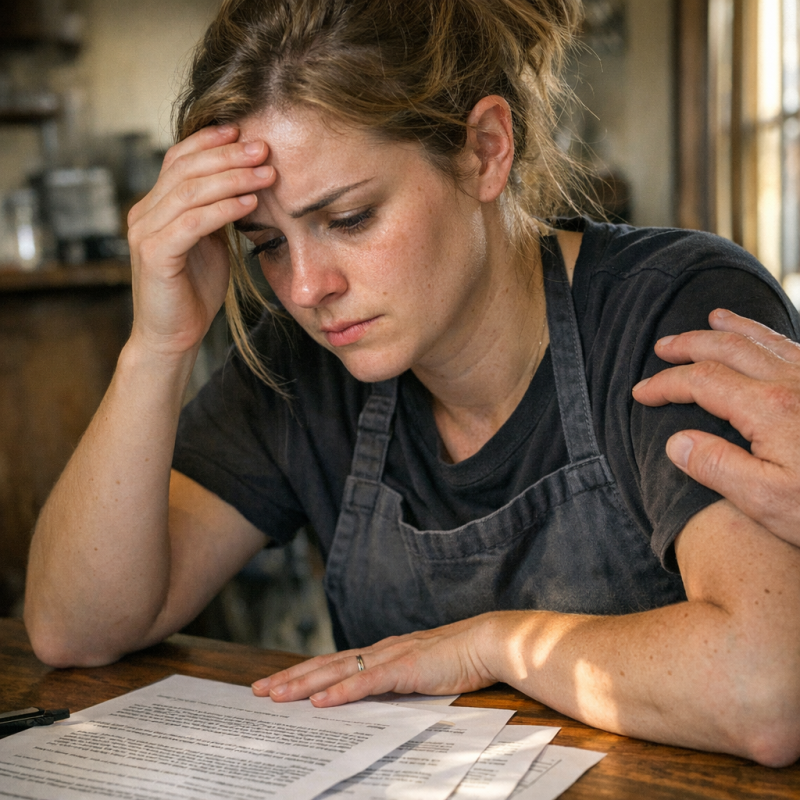 Image by FCT AI
Going Public
The attorney connected me with four other victims who'd been in the same settlement file. We met on a video call—servers from Ohio, Pennsylvania, Illinois, and Texas. All of us had the same haunted look when we talked about what happened. All of us had been fired, blacklisted, financially destroyed. And all of us were done being silent. 'We go public,' said the server from Ohio, a guy named Marcus who'd lost his entire career over this. 'We tell everyone exactly what they did.' The attorney explained that a press conference would expose Richard and Helen's scheme but also put targets on our backs. More legal threats. More intimidation. But we'd already survived the worst they could do. David helped me write my statement. I practiced it until my voice stopped shaking. We scheduled the press conference for the following Tuesday at a downtown hotel. The attorney would announce the civil suit. We would tell our stories. The media was already interested—the fraud angle made this bigger than just workplace disputes. I barely slept the night before. Then, Tuesday morning at six a.m., my phone rang. Richard's attorney. Offering a settlement if we stayed silent.
 Image by FCT AI
The Press Conference
The hotel conference room was packed with reporters and cameras. I sat at a table with Marcus and the other victims, our attorney at the center. My hands were shaking so badly I had to grip the table edge. But when the attorney introduced me and I stepped up to the microphone, something shifted. I wasn't scared anymore. I was angry. I told them everything. The casual conversation that became a trap. The impossible steak order. Helen's silent note-taking. The complaint designed to destroy my credibility. The settlement offers meant to silence me. The forty-one other servers they'd done this to. 'They turned fraud into a business model,' I said, my voice steady now. 'They targeted service workers because they thought we couldn't fight back.' The room was absolutely silent except for camera shutters. Marcus spoke next, then the others. Each story the same script with different details. Reporters were taking notes frantically, asking questions about the settlement amounts, the legal strategy, the corporate complicity. I felt lighter than I had in months. Then someone asked if we were pressing charges. Our attorney smiled. 'Criminal charges were filed this morning.'
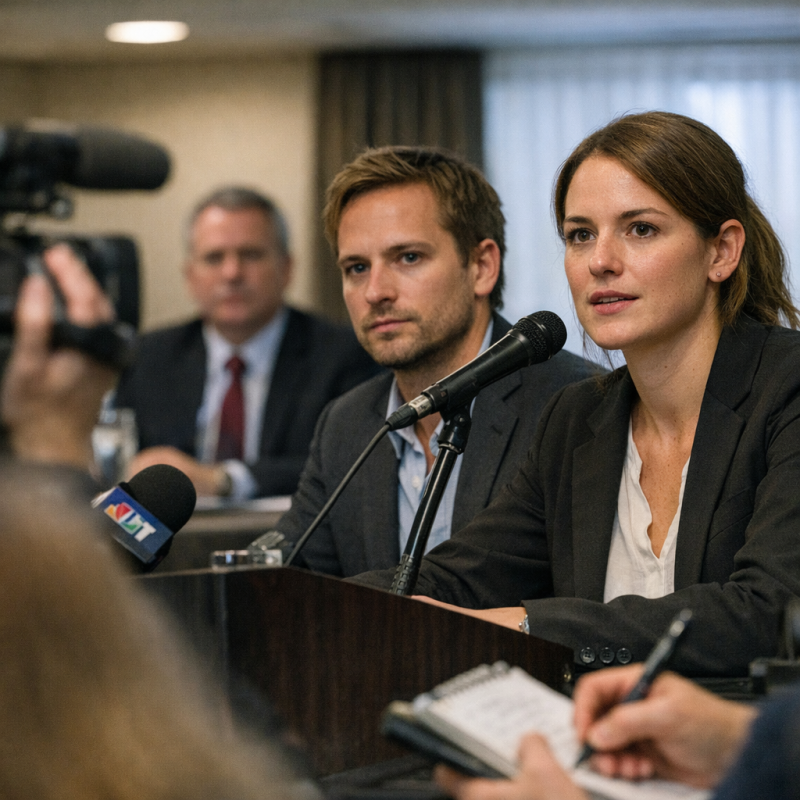 Image by FCT AI
The Media Firestorm
By noon, the story was on every major news outlet. 'Couple Accused of Running Multi-State Restaurant Fraud Scheme.' 'Serial Complainants Allegedly Defrauded Dozens of Servers.' The details were everywhere—the settlement amounts, the spreadsheet, Helen's note-taking, the scripted provocations. My phone wouldn't stop buzzing. News requests. Messages from people I hadn't talked to in years. Tessa called crying, saying she was so proud of me. David fielded interview requests while I tried to process that the secret I'd been carrying was now public knowledge. But the wildest part? Other victims started coming forward. Servers who'd settled years ago and signed NDAs. People who'd been too scared to speak up before. By late afternoon, the count was over sixty. The attorney was collecting statements, building a massive case. Corporate issued a statement about 'taking these allegations seriously' and 'conducting a thorough review,' which honestly felt like too little too late. Then, around seven p.m., David's phone lit up with a news alert. The FBI announced they were opening an investigation into wire fraud and racketeering.
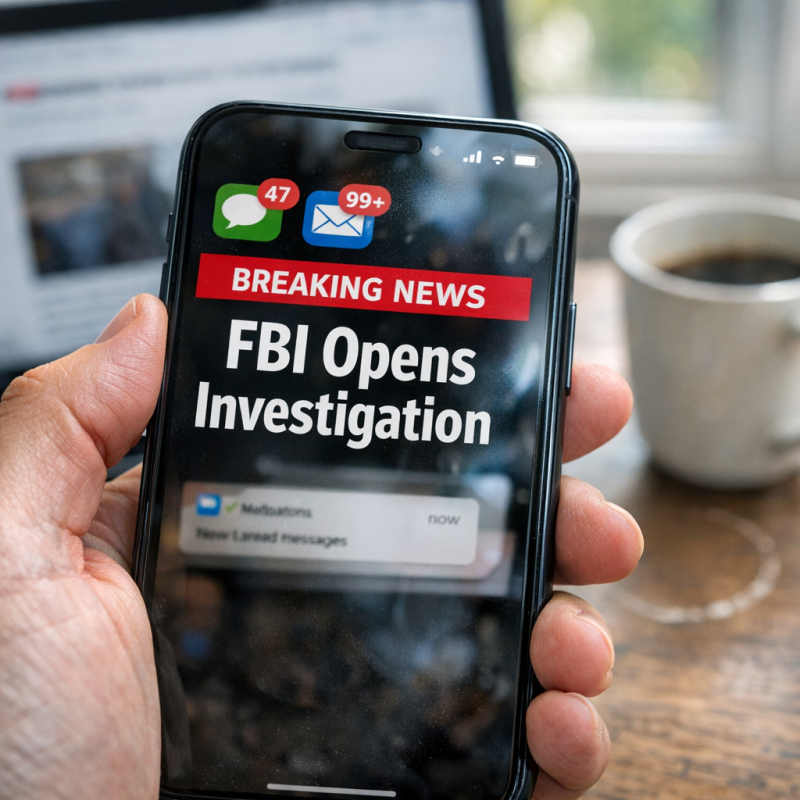 Image by FCT AI
Richard and Helen's Response
Richard and Helen tried to control the narrative with a television interview two days later. I watched it live with David and Tessa, all of us crowded around my laptop. They sat together on a pristine white couch, dressed like they were going to church. Richard spoke first, calling the accusations 'a coordinated attack by disgruntled service workers.' Helen nodded along, playing the supportive wife. They claimed they'd been 'targeted for having standards' and 'unfairly portrayed as villains' for simply expecting good service. The host pushed back, asking about the settlement spreadsheet. Richard called it 'record-keeping, nothing more.' When asked about the identical complaint language across different states, he said it was 'coincidence.' I was watching their performance fall apart in real time. The host wasn't buying it. Then she pulled out a photocopy of something—Helen's notebook, seized as evidence. 'Mrs. Turner, your notes from a 2019 incident describe the server as 'taking the bait perfectly.' How is that coincidence?' Helen's face went white. The host read more entries. 'Server defensive, as planned.' 'Complaint filed, standard script.' Everything they'd been denying was right there in Helen's handwriting.
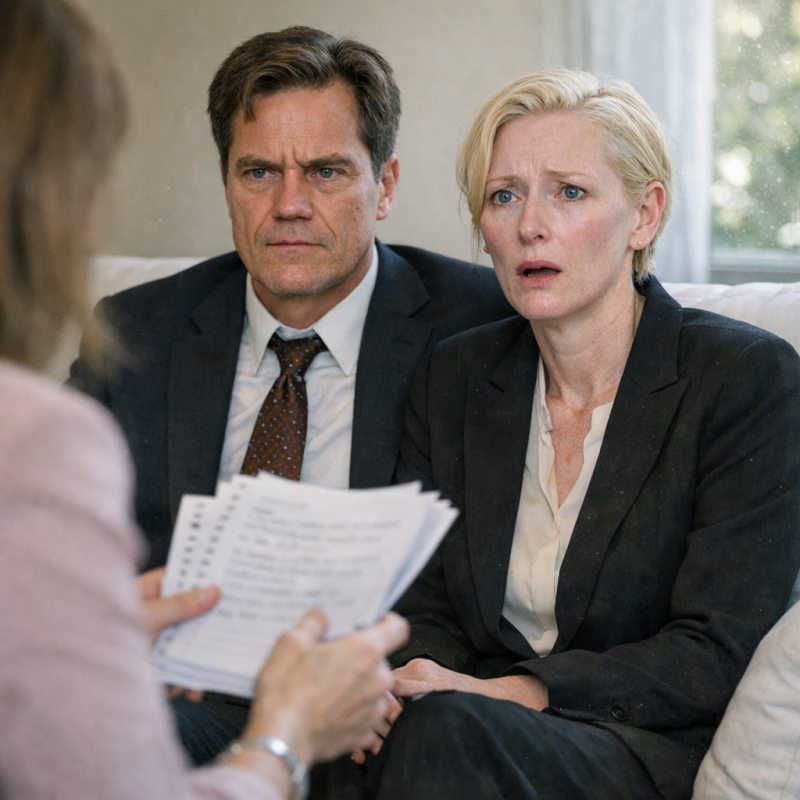 Image by FCT AI
Corporate's Reckoning
The restaurant chain spent the next week in absolute chaos. Their stock dropped. Franchisees were threatening lawsuits. Former employees were coming forward with stories about how corporate had pressured them to settle Richard's complaints quietly. The media was relentless—digging into every settlement, every policy decision, every email that showed corporate knew exactly what was happening. Lisa called me directly, which was surreal. She sounded exhausted. 'Maya, I want you to know that I pushed back on your case. I documented my objections. But I was overruled.' I didn't know if that made it better or worse. Jerome reached out too, saying he'd been placed on administrative leave for 'mishandling the investigation.' Corporate announced a complete policy overhaul three days later. No more forced arbitration. Independent investigation for all discrimination complaints. Mandatory training. And a victim compensation fund—five million dollars set aside for everyone Richard and Helen had targeted. The attorney said it was a good start but didn't absolve them of responsibility. Then Lisa called again with a question I wasn't expecting. 'Would you ever consider coming back? Not to your old position. Corporate wants to create an employee advocacy role.'
 Image by FCT AI
The Criminal Trial Begins
The criminal trial started in late September. Federal courthouse, serious charges. I sat in the gallery for jury selection, watching Richard and Helen with their defense team. They looked smaller somehow. Less intimidating. Just two people who'd spent years hurting others and finally got caught. When it was my turn to testify, I wore the same outfit I'd worn to the press conference. The prosecutor walked me through everything—the initial encounter, the complaint, the aftermath. Richard's attorney tried to rattle me during cross-examination, suggesting I'd been 'looking for a payday,' that I'd 'manufactured outrage' for attention. I stayed calm. 'I lost my job, my savings, and my sense of safety,' I said. 'What exactly did I gain?' Other victims testified too. Marcus. The server from Pennsylvania who'd been fired while supporting her disabled mother. A college student who'd dropped out because he couldn't afford tuition after losing his job. The prosecutor presented Helen's notebook, the spreadsheet, the settlement documents. The evidence was overwhelming. On my final day in court, I was asked to give an impact statement. I looked directly at Richard. 'Your scripted racism nearly destroyed my life.'
 Image by FCT AI
The Verdict
The jury deliberated for six hours. David sat with me in the courthouse hallway, neither of us speaking much. When we were called back in, I could barely breathe. The judge asked the jury foreperson to stand. Guilty on all counts of fraud. Guilty on conspiracy. Guilty on racketeering. I felt David grab my hand. Around us, other victims were crying, hugging each other. Richard stared straight ahead, expressionless. Helen sat perfectly still, her hands folded in her lap like she was at a dinner party. The judge began reading the counts one by one, each 'guilty' verdict landing like a hammer. I watched Richard's attorney lean over to whisper something. That's when Helen moved. She stood up suddenly, her chair scraping loud against the floor. 'This is insane!' she screamed, her voice cutting through the courtroom. The composure she'd maintained for years—through every restaurant, every complaint, every silent performance—completely shattered. 'We built something! We had a system that worked! These people ruined everything!' As the bailiff moved toward her, Helen finally broke her silence—screaming that we'd ruined everything they'd built.
 Image by FCT AI
Sentencing
The sentencing hearing was two weeks later. Richard and Helen sat at the defense table in matching expressions of barely-contained fury. The prosecution had recommended the maximum: fifteen years for Richard, twelve for Helen. Their attorney argued for leniency, claimed they'd already lost everything—their reputation, their businesses, their standing in the community. I almost laughed. They still didn't get it. The judge listened to victim impact statements for nearly three hours. Restaurant workers, suppliers, former business partners—all telling stories of manipulation and financial ruin. When it was my turn, I kept it simple: 'They made me believe I was the problem. That my concerns didn't matter. That I was disposable.' The judge sentenced Richard to fourteen years in federal prison. Helen got ten. Full restitution to all victims, plus additional fines. As the bailiff prepared to take them away, the judge leaned forward. Her voice was steady and clear. 'You didn't just steal money. You stole people's dignity and livelihoods. That ends today.'
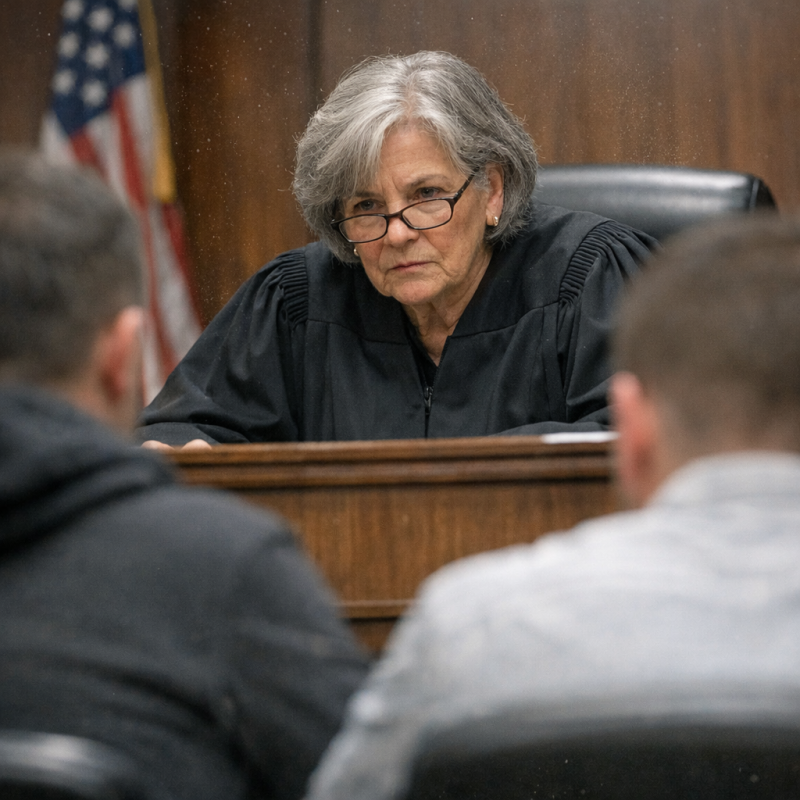 Image by FCT AI
Returning to the Restaurant
Marcus called three days after the sentencing. The corporate office wanted me back—not just my old position, but as a trainer and consultant. Better pay, better hours, actual benefits. I said yes before he finished explaining. My first shift back was surreal. Tessa hugged me so hard I couldn't breathe. Brandon gave me a fist bump from the kitchen window. The lunch rush felt familiar and completely foreign at the same time. I knew every table, every quirk of the POS system, every shortcut through the dining room. But I moved differently now. Stood differently. When a customer snapped his fingers at me, I stopped, looked him directly in the eye, and calmly asked how I could help. He apologized immediately. Tessa watched from across the room, her eyebrows raised in approval. The afternoon crawled by in a blur of orders and small talk. As I clocked out, I caught my reflection in the chrome trim by the kitchen. Walking through those doors again, I realized I wasn't the same person who'd been escorted out in shame.
 Image by FCT AI
Creating Change
Carol and Lisa flew in from corporate to develop the new training program. We spent weeks building it: how to recognize discriminatory behavior, how to document incidents, how to report without fear of retaliation. The company rolled it out chain-wide within six months. I became the face of it—traveling to different locations, telling my story, teaching servers that they had rights. Some managers resented it. Some servers were skeptical. But most people listened. At the Chicago location, a nineteen-year-old server named Emily told me she'd been dealing with a regular who made inappropriate comments every visit. After the training, she reported him. Management backed her up, banned him permanently. She cried when she thanked me. I told her she'd done the hard part herself. In Boston, we revised the entire incident reporting system. In Phoenix, we changed how managers responded to customer complaints about staff. Small changes, maybe. But they added up. At the first training session in Denver, a young server asked how I'd found the courage to fight back—and I told her she already had it.
 Image by FCT AI
A Simple Question
I still work at the restaurant most weeks. Still take orders, still deal with difficult customers, still ask how people want their steaks cooked. But everything's different now. The question itself hasn't changed—it's the same words, the same menu, the same routine. What changed was understanding that those small moments matter. That patterns reveal themselves if you're paying attention. That sometimes the way someone orders dinner tells you everything you need to know about how they see the world. David and I got married last year. Small ceremony, mostly family. Tessa was my maid of honor. We still live in the same apartment, still argue about whose turn it is to do dishes. Normal life, you know? But I carry the experience with me everywhere. When I'm training new servers, when I'm taking orders, when someone treats me like I'm invisible—I remember. I remember that I'm not crazy. That my instincts matter. That speaking up can cost you everything and still be worth it. Now when I ask 'How would you like that cooked?' I know exactly what I'm really asking: Do you see me as a person, or an opportunity?
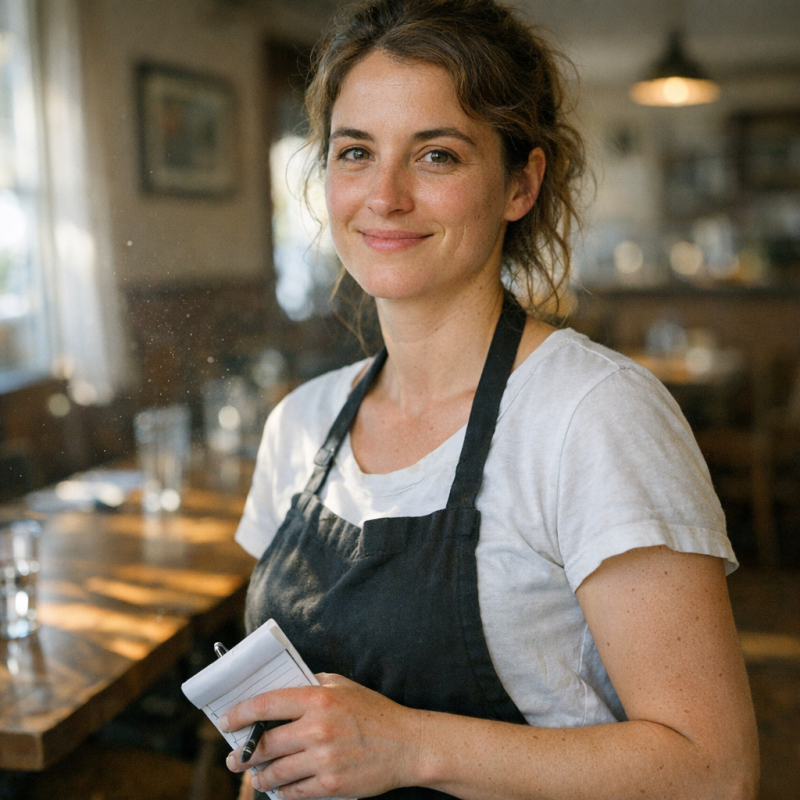 Image by FCT AI