
The Announcement
Lorraine announced it over Sunday dinner, her voice steady and matter-of-fact, like she was commenting on the weather. 'I'll be moving in with you both,' she said, setting down her fork with finality. 'My doctor thinks it's best I not live alone anymore.' I looked at Daniel, waiting for him to say something, anything—to explain this was a misunderstanding or at least a conversation we'd have privately first. But he just sat there, staring at his plate, his jaw tight. The silence stretched between us like a chasm. I could feel my heart hammering against my ribs as I processed what was happening. This wasn't a request. This wasn't even a discussion. It was a decree, and apparently, one my husband had already accepted without consulting me. I forced myself to swallow the bite of food that had turned to paste in my mouth. Lorraine was watching me with those pale blue eyes, waiting for my reaction. I managed a small nod, my mind already racing ahead. In that moment, I realized I had a choice: lose myself or find another way.
 Image by FCT AI
The History Between Us
The thing is, this didn't come out of nowhere. I'd been dealing with Lorraine's 'suggestions' since Daniel and I started dating six years ago. She'd commented on everything—my career choice ('social work doesn't pay well, does it?'), my cooking ('Daniel prefers his pasta al dente'), even my laugh ('a bit loud for public spaces'). Each criticism was delivered with a smile, wrapped in concern, impossible to confront without looking oversensitive. Daniel always defended her intentions. 'She just wants the best for us,' he'd say. But I noticed how she'd call during our date nights, how she'd need him for 'emergencies' that somehow resolved themselves before he arrived. When we got engaged, she cried—not happy tears—and told Daniel she worried I wasn't 'robust enough' for their family. At our wedding, she wore white. Not ivory, not cream. White. I'd swallowed it all, convinced myself these were minor irritations, the price of marrying someone who loved his mother. I never imagined it would lead to this—her in my home, permanently.
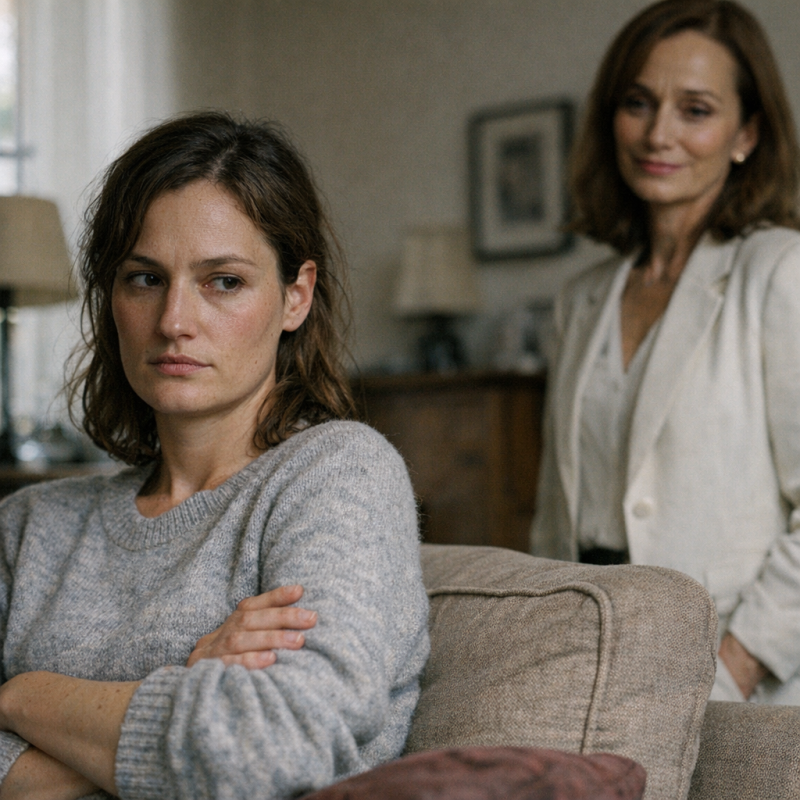 Image by FCT AI
Daniel's Burden
That night, after Lorraine left, Daniel finally explained. We sat in our bedroom, and he looked exhausted, ten years older than his thirty-seven. 'She's having dizzy spells,' he said quietly. 'They're running tests for her heart. She nearly fell last week coming up her stairs.' I felt my defensiveness crack a little. This was real. This was his mother's health, not just her manipulation. 'I know she can be difficult,' he continued, reaching for my hand. 'But she raised me alone after Dad passed. She worked two jobs so I could go to college. I can't just abandon her now.' The guilt in his voice was thick, familiar. I'd heard it before, every time Lorraine needed something. 'We'll make it work,' he promised. 'It won't be forever. Just until she's stable.' I wanted to believe him. I really did. I asked the question already lodged like a stone in my throat: 'How long, Daniel? How long will she stay?' But when I asked how long she would stay, he wouldn't meet my eyes.
 Image by FCT AI
The Quiet Agreement
I agreed the next morning, over coffee. Daniel looked so grateful, so relieved, that I almost felt guilty for what I was already planning. 'Thank you,' he said, kissing my forehead. 'I know this is a sacrifice. I'll make it up to you.' I smiled and told him we were family, that we'd figure it out together. All the right words. But while he called Lorraine to share the good news, I was already composing an email on my phone to a real estate agent I'd found online. I'd been thinking about it all night, lying awake while Daniel slept. If Lorraine was moving in, I needed an exit strategy—not from my marriage, but from the suffocation I knew was coming. I had some money saved from my grandmother's estate, kept separate in an account Daniel didn't know about. Not hidden, exactly. Just private. I wasn't sure yet what I'd do with it, but I needed options. Daniel's relief was immediate—but I had already started making calls.
 Image by FCT AI
Preparing the Room
We spent the next two weeks converting my downstairs office into a bedroom. It had been my sanctuary—a space where I could close the door and decompress after difficult days at the women's shelter where I worked. Now we were installing grab bars and moving in a hospital bed with adjustable rails. Daniel did most of the physical work, but I was there too, packing up my books, my desk, the framed photo of me and my late father. Each item felt like a small surrender. 'Where should we put your things?' Daniel asked, holding a box of my counseling certifications. 'The basement, I guess,' I said, though we both knew that meant they'd stay packed indefinitely. I watched him carry out the reading chair my grandmother had left me, the one I'd curled up in countless evenings. The room was starting to look clinical, institutional. As I installed the last railing, tightening the screws into our wall, I wondered if I'd ever get this room back.
 Image by FCT AI
Move-In Day
Lorraine arrived on a Saturday with her friend Margaret driving a U-Haul that seemed impossibly large for one person's belongings. I'd expected a few suitcases, maybe some medical equipment. Instead, boxes kept coming—kitchen items, decorative pillows, artwork, a full set of dining chairs. 'Where do you want these?' Daniel asked, holding a box labeled 'Living Room Décor.' Lorraine was already inside, walking through our space with an appraising eye. She moved one of my throw pillows, repositioned a photo frame, adjusted the angle of our couch. 'You don't mind, do you, dear?' she asked, not waiting for an answer. 'I just need to feel somewhat at home.' Margaret gave me a sympathetic look as she hauled in another box. I helped unpack in silence, watching this woman redistribute our shared space into something else. She paused in the doorway between the living room and kitchen, surveying everything with her hands on her hips. She looked around our living room and said, 'This will need some changes.'
 Image by FCT AI
The First Criticism
The kitchen comments started on day three. I was unloading the dishwasher before work when Lorraine appeared in her robe, watching me. 'You keep the glasses on the top shelf?' she asked, her tone light but pointed. 'I've always found them more accessible near the sink.' She opened the cabinet and began moving things around. 'And the spices—alphabetical is far more efficient than this grouping system.' I stood there with a plate in my hand, watching her reorganize my kitchen. 'Lorraine, I have a system that works for me,' I said carefully. She smiled that patient smile. 'Of course, dear. I'm just suggesting a better way. Daniel grew up with things organized properly.' I looked at Daniel, who'd just walked in for coffee. He was scrolling through his phone, deliberately not engaging. 'Daniel?' I said, needing him to back me up on this one thing. He glanced up, saw what was happening, and mumbled something about being late for work. Daniel said nothing, and I realized he never would.
 Image by FCT AI
Adjusting Routines
Within two weeks, our entire routine had transformed. Lorraine needed breakfast by seven-thirty, so my morning run got cut. She watched specific television shows at specific times, which meant Daniel and I retreated to our bedroom most evenings. She preferred particular brands at the grocery store, cooked meals that Daniel remembered from childhood, and somehow our diet became hers. 'She's just settling in,' Daniel would say when I tried to talk about it. But it wasn't just settling in. It was replacement. Our coffee maker was switched out for her old percolator because 'it brews properly.' Our weekend farmer's market trips stopped because Lorraine found them 'unnecessary' when there was a perfectly good supermarket nearby. I found myself asking permission to use my own living room, timing my movements around her schedule, apologizing for existing in my own space. One morning, I woke up early and sat in my car in the driveway for twenty minutes before work, just to be alone. I started waking up in my own house feeling like a guest.
 Image by FCT AI
The Grocery List
She caught me before I left for work on Tuesday. The list was typed — actually typed on her old typewriter and then printed somehow — single-spaced, organized by grocery store aisle. Organic chicken, not the regular kind. A specific brand of yogurt I'd never heard of. Prunes, cream of wheat, decaf coffee pods. At the bottom, in parentheses: 'Please purchase before Thursday as I'll need these items for the week ahead.' Not 'we'll need.' Not 'could you grab these when you get a chance.' A directive, itemized and precise. She handed it to me like I was the housekeeper receiving instructions. I stared at it, then at her, waiting for the 'please' that never came. She just smiled that thin smile and turned back to her morning show. Something shifted in my chest right then. Not anger, exactly. Something colder. I folded the list carefully, tucked it in my bag, and said, 'Sure, Lorraine.' But walking to my car, I felt it — the click of a door closing somewhere inside me. I took the list without a word — but I was done being directed.
 Image by FCT AI
The First Research
That night, after Daniel fell asleep, I sat on the bathroom floor with my laptop balanced on my knees. I typed 'in-home care services' into the search bar and watched the results populate. Senior companion services. Part-time caregivers. Full-time nursing assistance. I clicked through websites, reading testimonials from families who'd needed help. The photos all showed smiling elderly people with professional caregivers, everyone looking relieved and cared for. I bookmarked three agencies that offered consultations. Then I cleared my browser history, closed the laptop, and sat there in the dark for a minute, listening to the sound of Lorraine's television through the wall. My hands were steady. My breathing was calm. This was the first decision I'd made about my own home in weeks, and I was making it alone, in secret, at eleven-thirty at night while sitting on a bathroom floor. But it felt like power returning to my body. If he wouldn't set boundaries, I'd create them myself.
 Image by FCT AI
The Dinner Directive
I was halfway through chopping vegetables when she appeared beside me. 'You're cutting those too thick,' Lorraine said, peering over my shoulder. 'Daniel prefers them smaller. More uniform.' She didn't move away. Just stood there, narrating my failures. The heat was too high. I should've started the rice first. That wasn't enough garlic. Did I know how to properly season a chicken? I kept chopping, my jaw tight, while she delivered a steady stream of corrections like a cooking show no one asked for. When I finally served dinner, Daniel took his first bite and said nothing. Just chewed, swallowed, reached for his water. Lorraine made a small approving sound. 'Much better than last time,' she announced, as if she'd supervised me into competence. I waited for Daniel to say something, anything. To tell his mother that I'd been cooking just fine for years, that maybe she could let me handle my own kitchen. He took another bite. The silence stretched. Daniel ate in silence, and I realized I was fighting this battle alone.
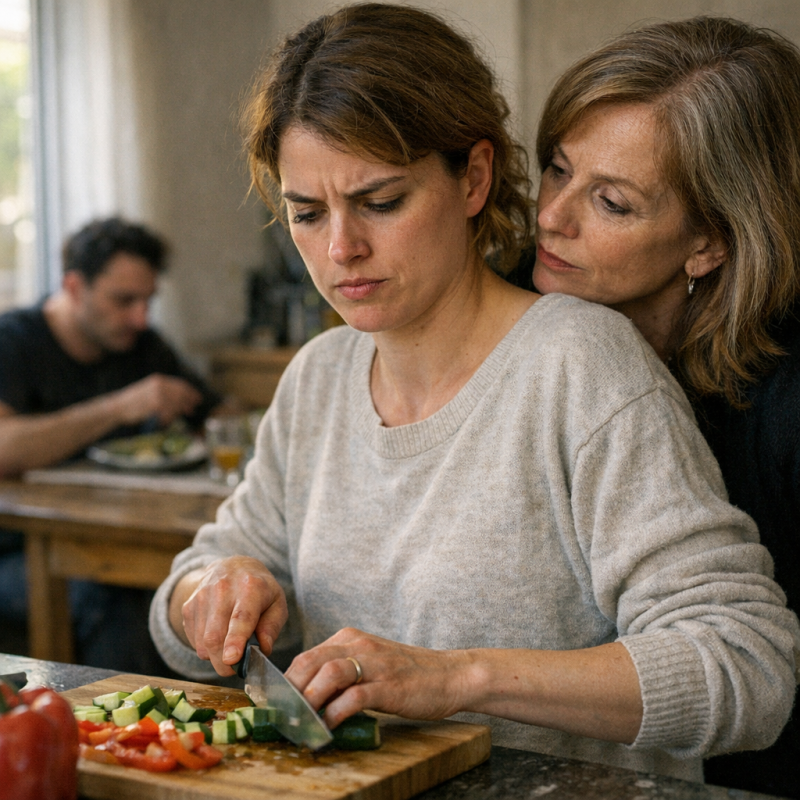 Image by FCT AI
The Laundry Incident
I'd started a load that morning before work — my usual routine, nothing special. But when I got home that evening, I found my wet clothes in a heap on top of the dryer, already starting to smell like mildew. Lorraine's laundry was spinning in the machine I'd been using. She was in the living room when I walked in, didn't even look up from her book. 'I needed to wash my bedding,' she said, like that explained everything. Like my schedule, my routine, my wet clothes sitting there ruined — none of it mattered compared to her immediate needs. I stood there holding my damp shirts, feeling something harden in my chest. I could've confronted her. Could've raised my voice, explained basic courtesy, asked what the heck she was thinking. But I didn't. I transferred her laundry to the dryer, restarted my own load, and went upstairs without a word. The anger was there, absolutely. But I was learning to let it crystallize into something sharper, colder, more useful. I found my wet clothes piled on the dryer — she'd needed the machine.
 Image by FCT AI
A Conversation Avoided
I waited until we were alone in our bedroom, door closed, voices low. 'Daniel, we need to talk about boundaries with your mom.' He was scrolling through his phone, didn't look up. 'What do you mean?' So I told him. The laundry, the grocery lists, the constant critiques. How I felt like a stranger in my own house. He finally glanced at me, but his expression wasn't concern — it was discomfort. 'She's just trying to help. You know how she is.' I tried again, more directly. 'I need you to talk to her about respecting our space. Our routine.' He sighed, that particular sigh that meant the conversation was already over. 'Can we not do this right now? She's going through a lot, adjusting to a new place. Just... give it time.' Then he changed the subject to something about work, his tone already lighter, like we'd resolved something instead of avoiding it entirely. He looked at me like I was the problem for even bringing it up.
 Image by FCT AI
The Medication Schedule
Thursday morning, Lorraine appeared with a plastic pill organizer and a handwritten medication schedule. 'I'll need you to fill this every Sunday,' she said, setting both on the kitchen counter in front of me. 'And here's a list of my doctor's appointments for the next three months. You'll need to remind me the day before each one.' I stared at the organizer, at her careful handwriting noting morning pills, evening pills, the ones that needed food. She'd color-coded it. There was a section for tracking blood pressure readings. Another for noting any 'concerns or symptoms' to discuss with her physician. This wasn't a request for occasional help. This was a job description. She stood there waiting, expectant, like I'd naturally accept this new role she'd created for me. Around us, the house hummed with her routines, her preferences, her needs. I picked up the pill organizer, felt its weight in my palm. 'Got it,' I said evenly. She handed me the pill organizer like it was my job now.
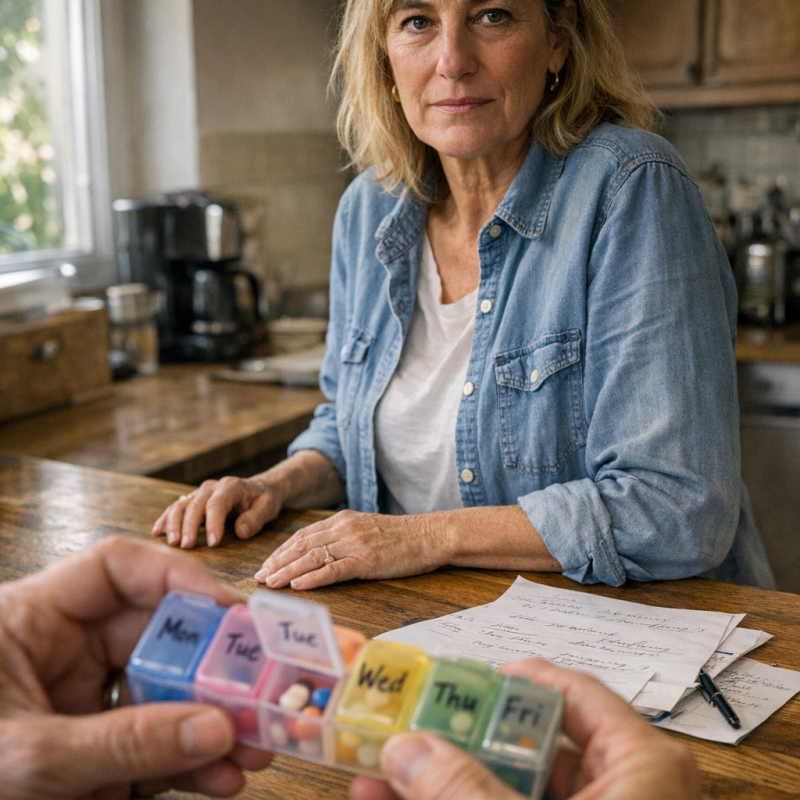 Image by FCT AI
The Agency Call
I made the call during my lunch break, sitting in my car in the parking garage. The agency was called ComfortCare Home Services, and the woman who answered sounded warm and professional. Her name was Carla. I explained the situation carefully — elderly mother-in-law, limited mobility, living with us, needing daily assistance. I didn't mention that she could actually do most things herself, or that this was about reclaiming my home rather than genuine medical necessity. Carla asked good questions about care needs, schedule preferences, budget. She didn't judge, didn't pry. Just took notes and outlined options. 'We could start with part-time companion care,' she suggested. 'Someone to help with daily activities, appointments, meal preparation. Take some pressure off the family.' Yes. Exactly that. We scheduled a consultation for the following week, a time when Daniel would be at work. 'And when would you need services to start?' Carla asked, her pen clicking softly in the background. I watched people walking past my car, living their normal lives. The woman on the phone asked when we'd need services to start — I said, 'Soon.'
 Image by FCT AI
The Living Room Takeover
The couch had been against the far wall that morning. Now it faced the television at a different angle. The coffee table was gone entirely — 'a tripping hazard,' Lorraine explained when I stood frozen in the doorway. She'd moved the armchair closer to the window, rearranged the side tables, even repositioned the lamp I'd spent an hour finding the perfect spot for. Daniel was helping her adjust a throw pillow. 'Much better flow for Mom's walker,' he said, not quite meeting my eyes. The room looked institutional now. Efficient. All the warm, carefully chosen touches I'd added over the years — rearranged or removed to accommodate equipment and mobility needs that were theoretical at best. My books were stacked in a corner. The artwork I'd hung was propped against the wall, waiting to be relocated. Lorraine settled into the repositioned armchair with a satisfied sigh. 'This works so much better,' she announced. Daniel nodded. Neither of them asked me. I came home to a different house — one that no longer felt like mine.
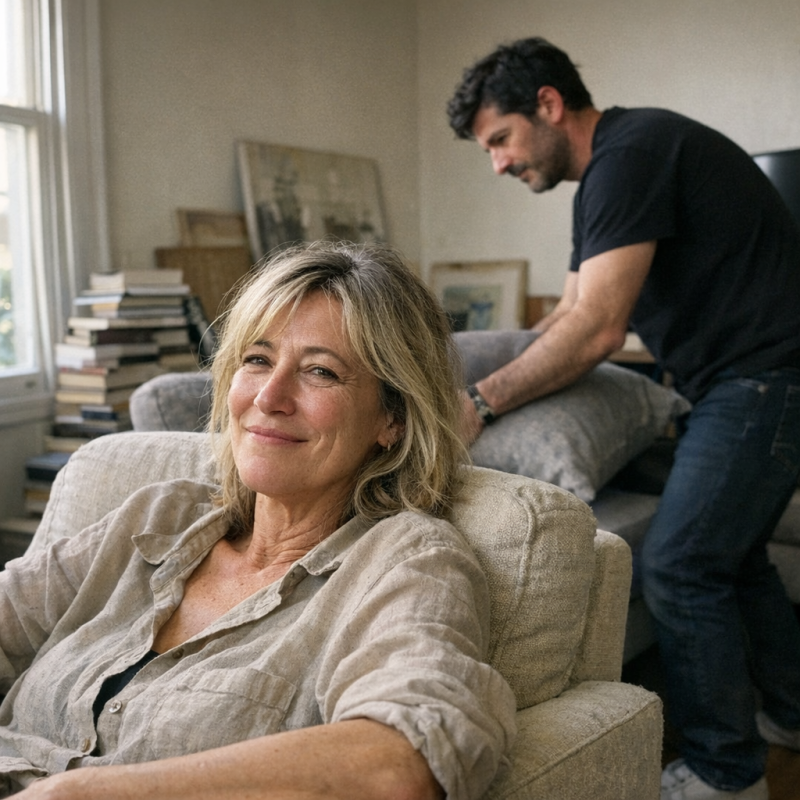 Image by FCT AI
The Consultation
Carla arrived on Tuesday morning, scheduled precisely when Daniel would be at the office. I'd told him it was a friend visiting. Not technically a lie — just strategic omission. She was younger than I expected, maybe late twenties, with kind eyes and a clipboard. She asked careful questions about Lorraine's mobility, her daily routine, her actual medical needs versus stated ones. I found myself answering honestly for the first time in weeks. 'She can walk fine,' I admitted. 'The walker is more... preventative.' Carla nodded, taking notes without judgment. We sat at the kitchen table, the one space Lorraine hadn't yet claimed as her territory. I watched Carla observe the rearranged living room visible through the doorway, the medical equipment staged like props, the institutional feel of what used to be my home. She set down her pen and looked at me directly. Not at the situation, not at the house — at me. Her voice was quiet, professional, but there was recognition in it. She glanced around and quietly said, 'You're drowning, aren't you?'
 Image by FCT AI
The Childlessness Comment
We were eating dinner when Lorraine brought it up again. 'You know, Daniel was such an easy baby,' she said, cutting her chicken with deliberate precision. 'I always imagined him with children of his own by now.' Daniel shifted beside me. I kept my eyes on my plate. 'We've talked about this, Mom,' he said quietly. But she wasn't finished. 'I just think it's such a shame to wait too long. A woman's window is so limited, you know. And Daniel would make such a wonderful father.' The implication hung there like smoke. That I was the one delaying. That I was depriving her of grandchildren. That my worth as a wife could be measured in my reproductive timeline. Daniel reached for the water pitcher, changing the subject to something about work. Lorraine continued eating, satisfied. I sat there feeling like I'd been slapped, the sting of it settling into my chest where all the other small wounds were collecting. She smiled sweetly while saying it — but the message was clear.
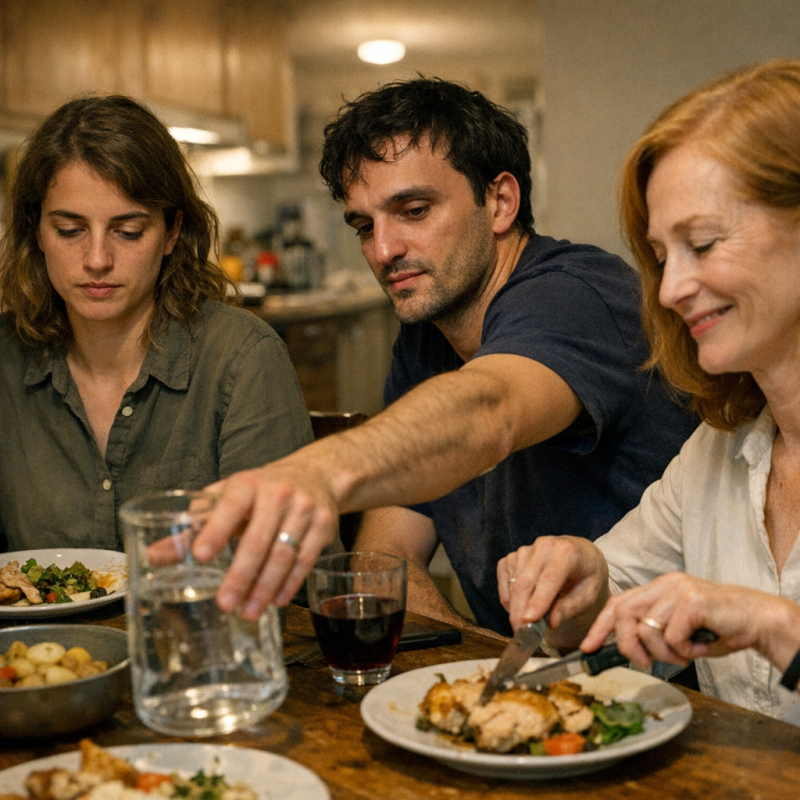 Image by FCT AI
The Hidden Invoice
The invoice came by email three days later. I opened it on my phone while Daniel was in the shower. Professional home care services, four hours daily, five days per week. The number made my stomach drop. It wasn't catastrophic, but it wasn't nothing either. I had savings from before the marriage, money I'd kept separate without really knowing why. Now I knew. I forwarded the invoice to my personal email and deleted it from the joint account inbox. Then I set up automatic payments from my individual checking account. Daniel would never see the statements. He'd never ask where Carla came from or how this was being funded. He was too busy managing his mother's feelings to notice mine. I sat on the edge of the bed, phone warm in my hand, calculating how many months I could sustain this before my savings ran dry. The answer didn't matter. The cost was significant — but so was my sanity.
 Image by FCT AI
Marcus's Concern
Marcus showed up unannounced on Saturday afternoon. My older brother had always been protective, sometimes annoyingly so, but I was grateful to see him. Lorraine was in the living room when he arrived, holding court from her repositioned throne. Daniel emerged from the kitchen to play host. I watched Marcus take in the scene — the medical equipment, the rearranged furniture, the way Daniel hovered near his mother. We made small talk for twenty minutes, awkward and strained. Then Marcus asked to see the garden, something we'd planted together last spring. Outside, away from the windows, his expression changed. 'How long has it been like this?' he asked. I tried to brush it off, to play the gracious daughter-in-law managing a difficult situation. He wasn't buying it. 'You look exhausted,' he continued. 'You look like you're walking on eggshells in your own house.' I started to protest, to defend, to explain. He pulled me aside and said, 'You don't look like yourself anymore.'
 Image by FCT AI
The TV Remote Battle
It started over the remote control. Such a small thing. I'd been watching a documentary when Lorraine emerged from the bathroom and announced she wanted to watch her evening program. I still had fifteen minutes left. 'Can I just finish this segment?' I asked. Her face tightened. 'I watch this program at seven-thirty every night. You know that.' I didn't know that. It was eight o'clock, and I'd been here first. But she stood there, hand extended, waiting. Daniel walked in from the kitchen just then. 'What's going on?' he asked. Before I could speak, Lorraine explained how she needed her routine, how important structure was for elderly people, how stressful disruption could be. I held the remote, this stupid piece of plastic, feeling the weight of everything it represented. Daniel looked at me with apologetic eyes. 'Maybe just this once?' he suggested. I handed it over. Lorraine won, and Daniel sided with her — again.
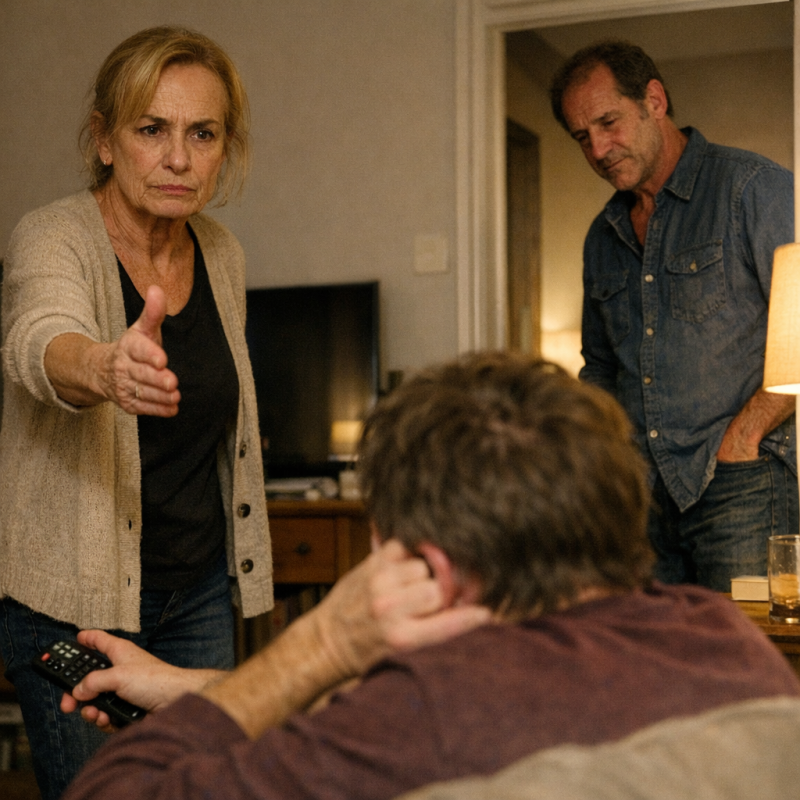 Image by FCT AI
The Final Paperwork
I signed the contract at my office during lunch, using the printer near my desk where no one would ask questions. My hand was steady as I wrote my name, steadier than I expected. Start date: one week from Monday. Four hours daily, Monday through Friday. Carla would arrive at nine a.m., after Daniel left for work. She'd provide companionship, light assistance, meal preparation — everything Lorraine claimed to need. Everything that would keep her occupied and out of my immediate space for precious hours each day. I scanned the signed documents and emailed them back. Then I updated my phone calendar with cryptic reminders: 'C arrives 9am' starting next week. Nothing that would raise questions if Daniel happened to see my screen. The plan was in motion now, no longer theoretical. I felt the weight of it, the commitment, the calculated deception. My marriage operated on half-truths and strategic omissions now. There was no turning back now — I had made my move.
 Image by FCT AI
The Guest Room Decree
Lorraine found me folding laundry in the bedroom. 'I've been thinking,' she began, that phrase I'd learned to dread. 'The guest room is just sitting empty. Such wasted space.' My hands stilled on the towel I was folding. We used that room. Friends visited. Marcus stayed there when he came to town. 'I have so many belongings still in storage,' she continued. 'Medical supplies, keepsakes, winter clothes. It would be so much more practical to have everything here where I can access it.' I looked at her standing in my doorway, in my bedroom, talking about claiming another room. 'We need the guest room,' I said carefully. She waved her hand dismissively. 'How often do you really have guests? And they can always get a hotel if needed. This just makes sense.' Her tone had shifted from suggestion to explanation. Not asking permission, just informing me of the new arrangement. She wasn't asking — she was telling.
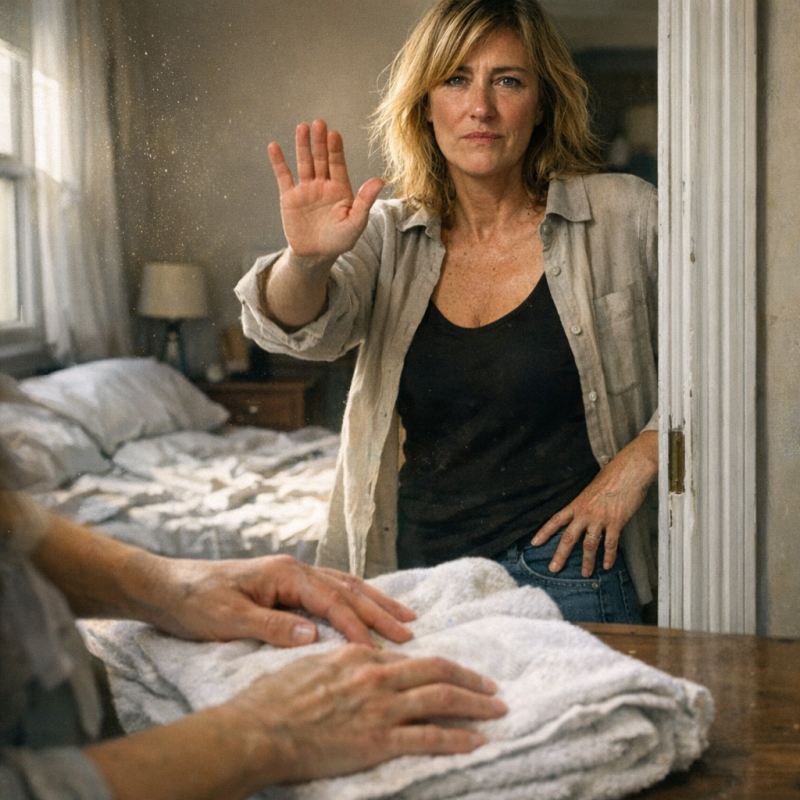 Image by FCT AI
The Marital Distance
Daniel came to bed after midnight again. I was already there, pretending to read, mostly staring at the same page. He moved quietly, considerately, like you do around strangers. We'd stopped talking about anything that mattered. Our conversations had become logistical exchanges about schedules and groceries and whose turn it was to take out the trash. He climbed under the covers, keeping to his side. The space between us felt vast, unbridgeable. I wanted to tell him about Carla, about the contract, about how I was solving the problem he refused to acknowledge. I wanted to tell him I was drowning in his mother's presence, suffocating under the weight of his divided loyalty. Instead, I turned off my lamp. He did the same. We lay there in the darkness, inches apart, silent. His breathing eventually steadied into sleep. Mine didn't. I stared at the ceiling, listening to him dream while I calculated how many more nights I could endure. I realized we were sleeping in the same bed but living in different worlds.
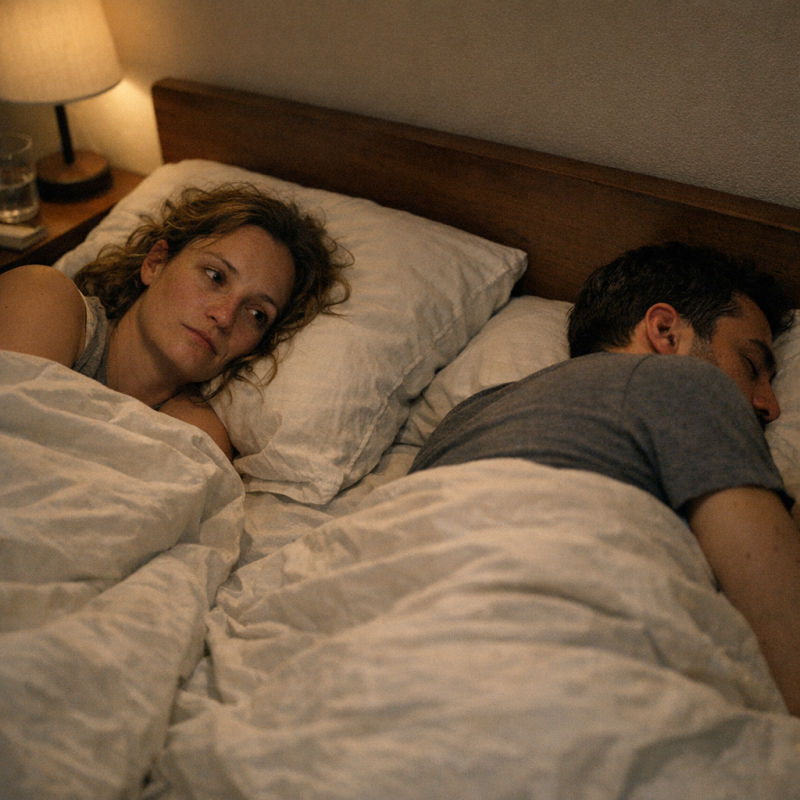 Image by FCT AI
The Cleaning Critique
I'd just finished cleaning the bathroom. Not just a quick wipe-down either—I'd scrubbed the grout, polished the fixtures, cleaned the mirror until it gleamed. I was rinsing the cloth when Lorraine appeared in the doorway. She surveyed my work with that particular expression she'd perfected, the one that looked thoughtful but was really just disapproval in disguise. 'Oh, sweetheart,' she said, stepping inside. 'You've missed several spots.' She pointed to areas I'd literally just cleaned. 'And you can't use that cleaner on these fixtures—it leaves residue.' She was already retrieving her own supplies from under the sink, the ones she'd brought from her house. I stood there, cloth in hand, watching her redo everything I'd just done. She narrated as she worked, explaining the 'proper' technique like I was a child learning basic hygiene. 'I hope you don't mind,' she said without looking at me. 'I just want to show you how it's done correctly.' The bathroom smelled like bleach and my own inadequacy. She said it was for my benefit—but it felt like humiliation.
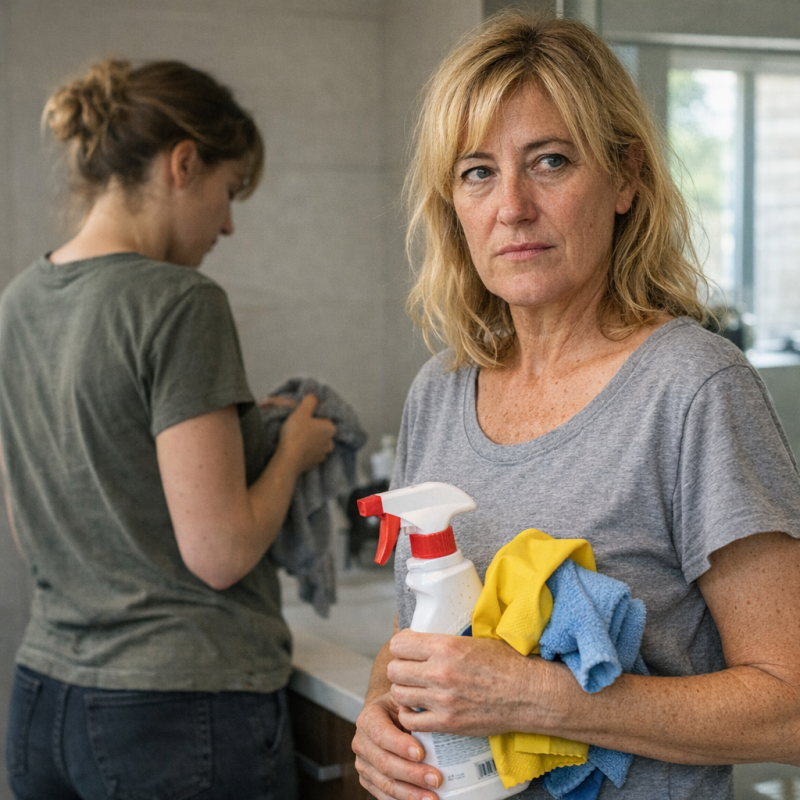 Image by FCT AI
The Countdown Begins
Three days. Carla would arrive in three days. I'd confirmed everything twice—her start date, her hours, the care plan. Now I just had to tell them. I rehearsed it constantly, testing different approaches in my head while I folded laundry or stared at my laptop pretending to work. Should I tell Daniel first, privately? Or announce it to both of them together? Each scenario had risks. Tell Daniel alone, and he might rally Lorraine before Carla arrived. Tell them together, and I'd face their united front without backup. I practiced my tone in the mirror, aiming for calm and matter-of-fact. 'I've arranged for professional help.' No, too clinical. 'I've hired someone to assist with Lorraine's care.' Better, but still felt weak. The words needed to be clear, final, inarguable. I lay awake those three nights, running through every possible reaction, every counterargument they might raise. The contract was signed. The deposit was paid. This was happening whether they liked it or not. I had one chance to get this right—or lose everything.
 Image by FCT AI
The Sunday Morning Tension
Sunday morning was supposed to be peaceful. Daniel made coffee. Lorraine settled in her usual chair with the newspaper, making small dissatisfied sounds at various articles. I sat at the kitchen table with my laptop, not really seeing the screen. The silence wasn't comfortable—it was thick, stifling, filled with everything we weren't saying. Daniel brought Lorraine her coffee first. Of course. 'Oh, this is a bit weak, dear,' she said. He immediately offered to make another pot. She waved him off with practiced martyrdom. 'No, no, I'll manage.' But her tone said she wouldn't forget it. I asked Daniel if he wanted to go for a walk later. 'Maybe,' he said, not looking up from his phone. Lorraine mentioned she might need help rearranging her closet. 'The shelves aren't quite right.' Daniel said he'd look at it after lunch. Nobody asked what I might need. Nobody asked how I was. The apartment felt smaller every minute, the air harder to breathe. We moved around each other like chess pieces, careful, strategic, waiting. The silence was louder than any argument could have been.
 Image by FCT AI
The Missed Spot
I was wiping down the kitchen counter after breakfast when Lorraine walked past, paused, then walked back. 'You missed a spot,' she said, pointing to an area I'd literally just cleaned. Something inside me cracked. Not broke—cracked. I could feel it, the fissure spreading through my chest. 'Right there,' she continued, leaning closer. 'And honestly, you should really use a different motion when you wipe. Back and forth, not circles. Circles just spread the crumbs around.' Daniel was right there at the table, scrolling through his phone, hearing all of this. He said nothing. Lorraine reached for the cloth in my hand. 'Here, let me show you—' That's when it happened. I pulled the cloth back. Held it against my chest. Looked directly at her for the first time in weeks, really looked at her. My heart was pounding so hard I could feel it in my throat. Daniel's eyes flickered up from his screen, sensing the shift in the room. I turned around slowly, and for the first time, I didn't swallow my response.
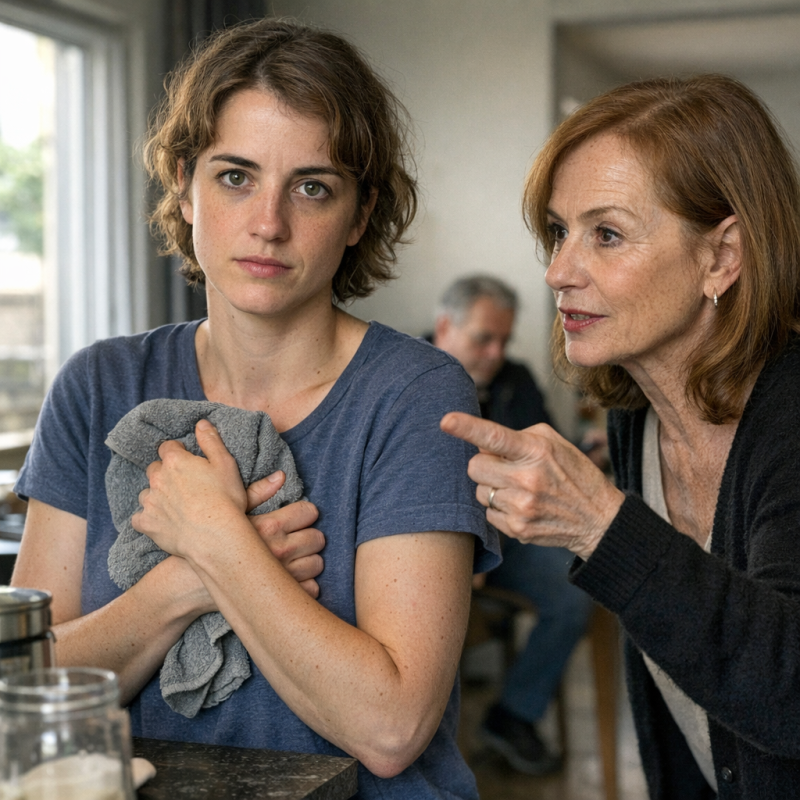 Image by FCT AI
Speaking Up
'I'm not your caregiver, Lorraine.' My voice came out steady, clearer than I expected. 'I never agreed to be.' She blinked at me, her hand still extended for the cloth. 'I moved here to build a life with Daniel, not to be criticized about how I clean counters or make coffee or fold towels.' The words were flowing now, months of silence breaking open. 'You need help, real help, and I can't provide that. I won't.' Lorraine's expression shifted from surprise to wounded confusion. 'I don't understand what you mean, dear. I'm not asking for anything unreasonable—' 'You're asking for everything,' I said. 'Every day. Every moment. And I have nothing left to give.' My hands were shaking but my voice held firm. Daniel was staring at me now, phone forgotten on the table. Lorraine's eyes were filling with tears, her signature move. 'Daniel, I don't know what's brought this on—' she started. I didn't let her finish. 'This has been building since the day you arrived.' The room went silent, and Daniel finally looked up from his phone.
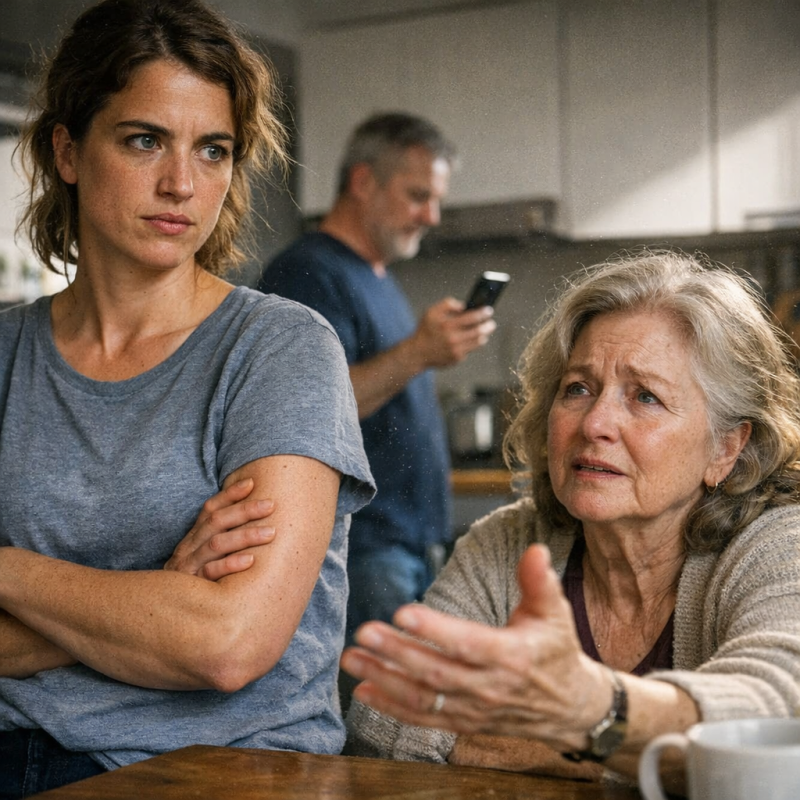 Image by FCT AI
The Pushback
Lorraine's voice went soft, wounded, the tone she always used when she needed Daniel's protection. 'I'm just trying not to be a burden,' she said, one hand fluttering to her chest. 'I help where I can. I offer suggestions because I care.' She looked at Daniel, her eyes wide and hurt. 'I'm not asking for much, am I? Just a little consideration? A little kindness in my old age?' My stomach dropped. I knew exactly what she was doing, had seen her do it a hundred times. But would Daniel see it? 'Mom's been through a lot,' he said quietly, and there it was. The choice he was making, right in front of me. 'She's just trying to help. Maybe you're overreacting a little?' Overreacting. That word. Like my feelings were excessive, unreasonable, too much. Lorraine's expression shifted subtly—I caught it before she smoothed it away. The smallest flash of satisfaction. 'I don't mean to cause problems between you two,' she said, her voice breaking slightly. 'That's the last thing I want.' She looked at Daniel for support—and he gave it to her.
 Image by FCT AI
The Reveal
'You don't need to cause problems,' I said, my voice surprisingly calm. 'Because I've already solved them.' Daniel's brow furrowed. Lorraine tilted her head, confused or pretending to be. 'I've hired a professional caregiver,' I continued. 'Her name is Carla. She starts tomorrow morning at nine.' The words landed like stones in still water. Daniel's mouth opened slightly. Lorraine went very still. 'She'll be here five days a week, eight hours a day,' I said. 'She's trained in elderly care, meal preparation, medication management, and companionship. I've signed a three-month contract.' 'You what?' Daniel's voice was barely above a whisper. 'When did you—' 'Two weeks ago,' I said. 'I interviewed three candidates. Carla was the best fit. Her references were impeccable.' Lorraine's hand went to her throat. 'But I don't need—' 'You do,' I said firmly. 'And I can't be the one to provide it. This way, you get proper care, and I get to be your daughter-in-law again instead of your nursemaid.' Both of them stared at me in shock—I had already made the decision.
 Image by FCT AI
Daniel's Anger
Lorraine excused herself, suddenly needing to lie down. The moment she was gone, Daniel turned on me. 'What the heck were you thinking?' His voice was low, shaking with anger. 'Making a decision like that without even talking to me?' 'I tried talking to you,' I clapped back. 'For weeks. You wouldn't listen.' 'So you just went behind my back? Hired someone? Signed a contract?' He was pacing now, running his hands through his hair. 'Do you have any idea how this makes me look? Like I can't take care of my own mother?' 'You're not taking care of her,' I said. 'I am. And I'm drowning.' 'That's not the point!' He stopped pacing, faced me directly. 'The point is you betrayed my trust. You made a major decision about my mother without consulting me. About our household. Our finances.' 'Our household stopped being ours the day she moved in,' I said quietly. He stared at me like I was a stranger. 'I can't believe you did this.' His voice was cold now, distant. He said I'd betrayed his trust—but I'd been losing myself.
 Image by FCT AI
Lorraine's Refusal
The next morning, Lorraine called me into the living room. She'd regained her composure overnight, that icy command settling back over her features. 'I've thought about this arrangement,' she said, folding her hands in her lap. 'And I'm afraid I cannot accept a stranger in my home. It's simply out of the question.' My home, she'd said. My. Like she'd signed the mortgage. Like she'd chosen the paint colors and argued over cabinet hardware. I felt something click into place inside me—something cold and clear. 'Actually, Lorraine,' I said, keeping my voice level, 'this is Daniel's and my home. You're a guest here.' The word hung between us. Guest. Her face went pale, then flushed deep red. 'How dare you—' 'The caregiver starts tomorrow,' I continued. 'You can cooperate or not, but she's coming either way.' I'd spent months tiptoeing around her feelings, bending myself into shapes to avoid conflict. That version of me felt like a stranger now. I corrected her quietly: 'This isn't your home.'
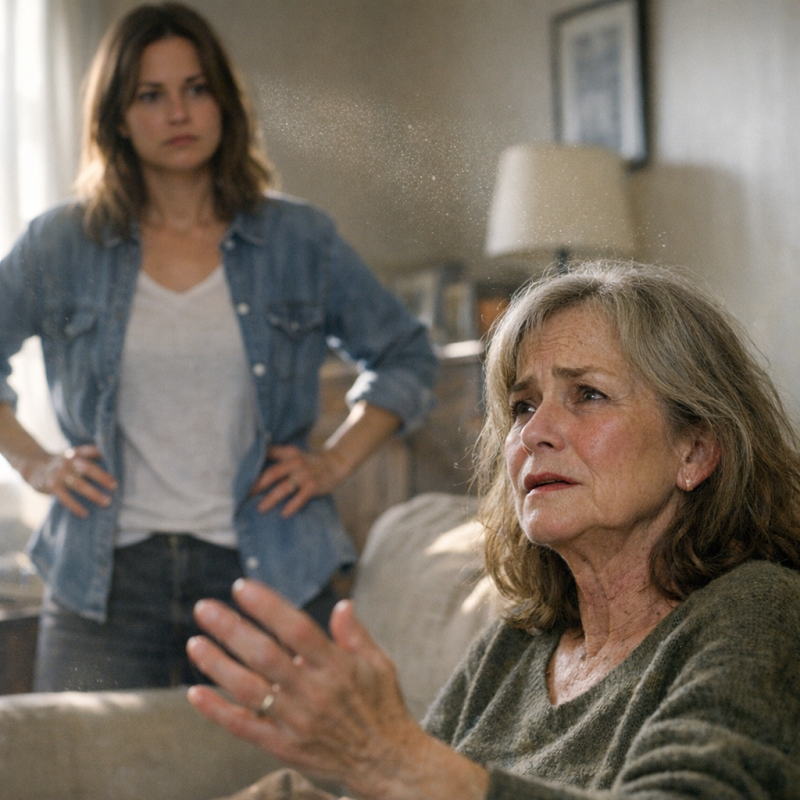 Image by FCT AI
The Night of Silence
That night, Daniel took his pillow to the guest room. He didn't announce it, didn't argue. He just gathered his things after dinner and walked past me without a word. We'd shared a bed for seven years—through illnesses and disagreements, through his night shifts and my insomnia. Even our worst fights had never put physical distance between us. Until now. I lay there in our bed, in the dark, listening to the unfamiliar silence. The house felt wrong without his breathing beside me, without the warmth of another body. I kept reaching for my phone, drafting texts I wouldn't send. Was I right? Was any of this worth it? I'd spent weeks fighting to save myself, but what if I'd just torched everything that mattered? The ceiling fan turned lazy circles above me. Outside, a car alarm went off, then stopped. My marriage was fracturing along fault lines I'd maybe always known were there but had chosen not to see. I lay awake wondering if I had just saved my life or destroyed my marriage.
 Image by FCT AI
Carla Arrives
Carla arrived at eight AM with a calm efficiency that felt like oxygen. She was younger than I'd expected—maybe late twenties—with kind eyes and the sort of steady presence that suggested nothing could rattle her. 'Mrs. Bennett?' she asked, extending her hand. 'I'm Carla. It's good to meet you.' I showed her around, explained Lorraine's routines, her preferences, the minefield of unspoken rules I'd been navigating for months. Carla took notes, asked practical questions, nodded. No judgment, no dramatics. Just professional competence. When I introduced her to Lorraine, my mother-in-law was sitting in her chair like a queen on a throne. She didn't stand. Didn't acknowledge Carla's greeting. Just stared past her toward the window, jaw set, spine rigid. 'Mrs. Hayes,' Carla tried again, her voice warm but not patronizing. 'I'm looking forward to working with you.' Nothing. Not even a flicker of recognition. The silence stretched until I started to sweat. Lorraine refused to even look at her.
 Image by FCT AI
The First Day
The first day was brutal. Lorraine stonewalled every attempt Carla made at connection. When Carla offered breakfast, Lorraine said she wasn't hungry. When Carla suggested a walk, Lorraine claimed exhaustion. Every question was met with one-word answers or silence. It was like watching someone try to build a bridge to an island that kept drifting further away. I hovered nearby, anxious, ready to intervene. This was a disaster. Lorraine would outlast her, wear her down, and I'd be back to square one with a failed experiment and a husband who'd never forgive me. But then I noticed something. Carla never took the bait. When Lorraine snapped at her, she responded with gentle neutrality. When Lorraine ignored her, she simply continued her work—straightening the room, organizing medications, maintaining routines without forcing interaction. There was no pleading, no frustration. Just steady, professional presence. By afternoon, Lorraine had stopped actively resisting and settled into cold dismissal. But Carla handled her with a skill I'd never seen before.
 Image by FCT AI
The Routine Shift
Within three days, something shifted in the house. Carla took over Lorraine's morning routine—medication, breakfast, light exercises. She managed the doctor's appointments and prescription refills. She fielded the constant requests that had been consuming my days. And suddenly, I had time. Actual time. I worked through lunch without interruption. I went to the grocery store alone. I took a bath that lasted longer than ten minutes. Small things, maybe, but they felt revolutionary. I hadn't realized how much of myself I'd lost until I started getting pieces back. The knot in my chest—the one that had been there so long I'd almost forgotten it existed—began to loosen. I wasn't waking up with dread anymore. Wasn't counting hours until I could escape to my office. The house still held tension, sure. Daniel was still barely speaking to me. But the crushing, daily pressure had eased. For the first time in weeks, I could breathe.
 Image by FCT AI
Daniel's Observation
Daniel still wasn't talking to me much, but I noticed him watching. He'd pause in doorways, observing Carla work. Taking in how she redirected Lorraine's complaints with gentle firmness, how she maintained boundaries without confrontation. One morning, I found him in the kitchen while Carla was helping his mother with her exercises in the living room. He was just standing there, coffee cup in hand, listening to their exchange. Lorraine was resisting, as usual. But Carla's voice remained calm, patient, professional. 'I know this feels unnecessary, Mrs. Hayes, but these movements help with circulation. Just five minutes.' He didn't say anything to me. Didn't acknowledge I was there. But something in his posture had softened—that rigid defensiveness that had defined him for weeks. His expression was thoughtful, almost contemplative. The anger was still there, I could feel it. But underneath, maybe something else was starting to surface. I caught him watching Carla work with something like understanding in his eyes.
 Image by FCT AI
Lorraine's Softening
It happened so gradually I almost missed it. Week one, Lorraine had been ice. Week two, she'd stopped actively sabotaging. By week three, she was responding to Carla's questions with actual sentences. Not friendly, exactly. But civil. She started accepting the meals Carla prepared without complaint. She stopped pretending she couldn't do things she was perfectly capable of doing. Small changes, but significant ones. One afternoon, I heard something that stopped me in my tracks: Lorraine laughing. Actually laughing at something Carla had said. When I peeked into the living room, Lorraine's face was still guarded, but there was a hint of warmth there I hadn't seen in months. She wasn't calling Carla by name yet—still referred to her as 'the girl' when talking to Daniel. But she'd stopped treating her like an intruder. She allowed the help without the martyrdom. It wasn't warmth, but it wasn't hostility either.
 Image by FCT AI
The Medical Discovery
Two weeks in, Carla asked to speak with me privately. My stomach dropped. She was quitting. This had all been too difficult, too harmful. But her expression was serious, not defeated. 'I've been reviewing Mrs. Hayes's medications,' she said, pulling out a detailed chart she'd created. 'And I noticed some concerning interactions. She's taking two medications that shouldn't be combined at these dosages. Plus, one of her prescriptions expired months ago, but she's still taking it.' I stared at the chart, feeling cold. How had I missed this? How had Daniel missed this? 'Has anyone reviewed this with her primary care physician recently?' Carla asked. I shook my head. We'd been managing refills through the pharmacy, following old prescriptions, assuming everything was fine. 'I'd like to schedule an appointment,' Carla said. 'Get everything properly reviewed and adjusted. Because honestly?' She looked at me with professional concern. She said, 'This could have been dangerous if left unchecked.'
 Image by FCT AI
A Conversation with Marcus
Marcus showed up unannounced on a Thursday afternoon, which was becoming his habit. I opened the door expecting his usual wry commentary, but instead he just looked at me for a long moment. 'What?' I asked, suddenly self-conscious. 'You look like yourself again,' he said simply. 'First time in months.' I didn't know how to respond to that. Was I different? I suppose I felt different. The constant tension in my shoulders had eased. I'd slept through the night twice that week. The house felt lighter with Carla managing things, with boundaries actually holding. We sat in the living room with coffee, talking about nothing important—his work, a movie he'd seen, mutual friends I'd barely kept in touch with. Normal conversation. When had that become such a luxury? As he was leaving, Marcus paused at the door and asked if I was okay now. I wanted to say yes. I wanted to believe it was that simple. But honesty forced me to temper my answer. I said I was getting there.
 Image by FCT AI
The Uneasy Feeling
The improvements were undeniable. Lorraine was more stable. Carla had everything running smoothly. Daniel seemed relieved, lighter. We were finding our rhythm again, carefully rebuilding what had been damaged. So why couldn't I shake this uneasy feeling? It started as a whisper I kept pushing away. Something about Lorraine's decline felt too convenient. Too perfectly timed. Too strategically designed to create maximum disruption right when our marriage needed space to breathe. I told myself I was being paranoid, looking for problems where none existed. We'd solved it. We had help now. Everything was better. But late at night, when the house was quiet and I couldn't sleep, the feeling crept back in. The way she'd arrived with such urgency. The way every small issue had escalated into crisis. The way Daniel had accepted it all without question, like he'd been through this script before. I started thinking back to when this all began—to those first phone calls, those initial complaints, the sudden escalation. And the timing felt strange.
 Image by FCT AI
Revisiting the Timeline
I couldn't stop myself from mentally tracing the timeline backward. Lorraine's health complaints had started last spring. Vague at first—fatigue, occasional dizziness, nothing alarming. Then they'd intensified over summer. By fall, she was calling Daniel multiple times a week about new symptoms, new concerns, new fears. And the real crisis—the one that brought her to our door—had erupted in November. November. I sat at the kitchen table with my laptop, staring at my calendar. Daniel had gotten his promotion in October. A significant one. More money, more prestige, more independence from the family business his father had built. We'd celebrated. We'd talked about finally taking that trip to Portugal we'd been planning. About maybe, eventually, starting a family. Then Lorraine's crisis had exploded, and everything else evaporated. Maybe it was coincidence. People get sick. Timing isn't always meaningful. But I kept seeing it: every time Daniel had gained something—independence, success, a relationship—something had pulled him back. Maybe it was coincidence. But I couldn't ignore the pattern.
 Image by FCT AI
The Old Photo Album
I found the photo album by accident, looking for our wedding photos to share with a friend. It was tucked behind our albums on the shelf—older, the binding cracked. I flipped through it idly at first. Daniel as a child. His college years. Then I stopped at a graduation photo. Daniel in his cap and gown, Lorraine beside him beaming, and on his other side, a young woman with dark hair and a bright smile. His arm around her waist. She looked comfortable there, like she belonged. I stared at that photo for a long time. I'd never heard Daniel mention a girlfriend from college. Never seen her in any photos before. Who was she? Where did she go? I brought the album to Daniel that evening, open to that page. 'Who's this?' I asked, keeping my voice casual. He glanced at it and something shuttered in his expression. 'Oh. Rachel. We dated senior year.' He closed the album gently. 'She just wasn't the right fit.' I waited for more. Nothing came. Daniel later told me she 'just wasn't the right fit'—but wouldn't elaborate.
 Image by FCT AI
A Conversation with Carla
Carla was reviewing Lorraine's physical therapy progress when she made the comment. 'Her mobility is actually quite good,' she said, not looking up from her notes. 'Better than the initial assessment suggested, honestly.' I looked up from my laptop. 'What do you mean?' Carla hesitated, choosing her words carefully. 'When I first evaluated her, she presented as someone with significant limitations. Difficulty with stairs, unsteady gait, needed constant assistance. But once we started structured therapy, her actual capacity became clearer. She's physically capable of much more than she was demonstrating.' My chest tightened. 'So she was... exaggerating?' 'I wouldn't say that exactly,' Carla said diplomatically. 'But sometimes when people are anxious or feeling vulnerable, they unconsciously amplify symptoms. Or sometimes it's not unconscious.' She met my eyes. 'Some people exaggerate symptoms when they need attention.' The words hung in the air between us. I thought about all those crisis calls. The dramatic decline. The perfect timing. She said, 'Some people exaggerate symptoms when they need attention.'
 Image by FCT AI
Daniel's Hesitation
I found Daniel in his study that evening, working late. I didn't plan the conversation. It just came out. 'Has your mother done this before?' I asked. He looked up, confused. 'Done what?' 'This. Moved in with you. Tried to move in. Created a health crisis that required you to drop everything and focus on her.' His expression changed. Guarded. Careful. 'Why are you asking that?' 'Because I need to know if this is a pattern. If this is something that happens whenever you—' I stopped, trying to articulate it. 'Whenever you try to build something separate from her.' Daniel stood up, walked to the window. His back to me. The silence stretched too long. 'Daniel.' 'It's complicated,' he finally said. 'How is it complicated? Has she done this before or not?' He turned to face me but still wouldn't meet my eyes. His jaw was tight. The muscle in his cheek twitched the way it did when he was trying to avoid something difficult. I waited. The silence was answer enough.
 Image by FCT AI
The Late-Night Search
I couldn't sleep that night. At two in the morning, I gave up and brought my laptop to bed. I typed carefully into the search bar: 'controlling parents manufactured crises.' The results flooded in. Article after article. Forum posts. Psychology blogs. Support groups for adult children of manipulative parents. I read for hours, my heart pounding harder with each page. The patterns were all there. Creating emergencies to demand attention. Manufacturing health crises to test loyalty. Sabotaging relationships that threatened their control. Using guilt and obligation as a means of control. I found myself nodding at descriptions of behaviors I'd witnessed firsthand. The convenient timing. The escalating demands. The way nothing was ever quite resolved, just temporarily managed until the next crisis. One phrase kept appearing across multiple sources, highlighted and repeated in bold: 'manufactured crises to maintain control.' I read testimonials from people who'd lived this. Partners who'd left. Adult children who'd finally set boundaries. The costs they'd paid. The years they'd lost. One phrase kept appearing: 'manufactured crises to maintain control.'
 Image by FCT AI
The Truth Comes Out
The next morning, I confronted Daniel directly. 'I need you to tell me about Rachel.' His face went pale. 'What about her?' 'I need you to tell me what really happened. Why she left. What your mother did.' He sat down heavily at the kitchen table. For a long moment, I thought he wouldn't answer. Then it all came out. Rachel had been his fiancée, not just a girlfriend. They'd been planning a wedding when Lorraine suddenly developed a serious health crisis—chest pains, difficulty breathing, possible heart problems. Rachel had tried to be supportive at first, but Lorraine's demands had escalated. She'd needed Daniel constantly. Criticized Rachel's attempts to help. Created conflict at every turn. When the medical tests came back normal, Lorraine claimed the doctors were wrong, that she needed more monitoring, more attention. Rachel had finally left, exhausted and heartbroken. 'She told me I had to choose,' Daniel said quietly. 'Between her and my mother.' He looked at me with devastating honesty. She had manufactured a health crisis to test loyalty, to assert control, to eliminate anyone who threatened her influence.
 Image by FCT AI
Reframing Everything
After Daniel left the room, I sat alone and replayed everything. Every single interaction. The sudden announcement about moving in. The elaborate medical documentation that had seemed so thorough. The way she'd criticized my cooking, my housekeeping, my schedule—always just enough to unsettle me, never quite enough to justify confrontation. The health scares that came at perfectly inconvenient moments. The subtle undermining of my relationship with Daniel, always framed as concern. The manufactured emergencies that pulled him away exactly when we needed time together. It all made terrible sense now. I remembered the night she'd 'forgotten' her medication and how panicked Daniel had been. I remembered her fainting spell the day before our anniversary. I remembered every tearful conversation about feeling unwanted, feeling like a burden—always timed to maximize guilt. She hadn't been testing whether I could care for her. She'd been testing whether I would break. Whether I would leave, like Rachel had. Whether I would prioritize her above everything else, or fight back. The realization settled over me like ice water. She hadn't needed to move in—she had chosen to, as a test.
 Image by FCT AI
Daniel's Confession
Daniel came back an hour later. His eyes were red. He sat across from me and started talking, words tumbling out like he'd been holding them in for decades. 'She's always been like this,' he said. 'Since I was a kid. Every girlfriend I had, every friend who got too close—she'd find a way to create conflict. I thought it was just her being protective. Worried I'd get hurt. But it was more than that.' He told me about high school, about a teacher who'd encouraged him to apply to universities far from home. Lorraine had developed mysterious symptoms that required him to stay close. About a best friend whose family she'd turned him against with carefully planted suggestions. About opportunity after opportunity he'd passed up because she'd needed him. 'I didn't even realize what I was doing,' he said, his voice breaking. 'I thought it was normal. Thought it meant I was a good son.' I reached across the table and took his hand. My anger at him softened, complicated by this new understanding. He looked at me with such raw pain. He said, 'I didn't know how to stop her without losing her.'
 Image by FCT AI
The Confrontation with Lorraine
I found Lorraine in the living room the next morning, sitting in her usual chair by the window. I'd rehearsed this conversation a dozen times in my head, but now that the moment was here, a strange calm settled over me. 'I know what you did,' I said simply. 'With Rachel. With Daniel's life. And with me.' She looked up from her book, her expression unreadable. I continued, keeping my voice steady. 'You manufactured a health crisis to break up Daniel's engagement. You've been doing it his whole life—creating situations that force him to choose you over everyone else. This whole living arrangement wasn't about you needing care. It was a test to see if I'd break like she did.' I waited for the denial. The outrage. The tears. The wounded mother act I'd seen so many times before. But Lorraine just set down her book carefully, smoothed her skirt, and met my eyes with an expression I'd never seen before. It was almost... satisfied. She didn't deny it—she just looked at me coldly and said, 'You passed the test.'
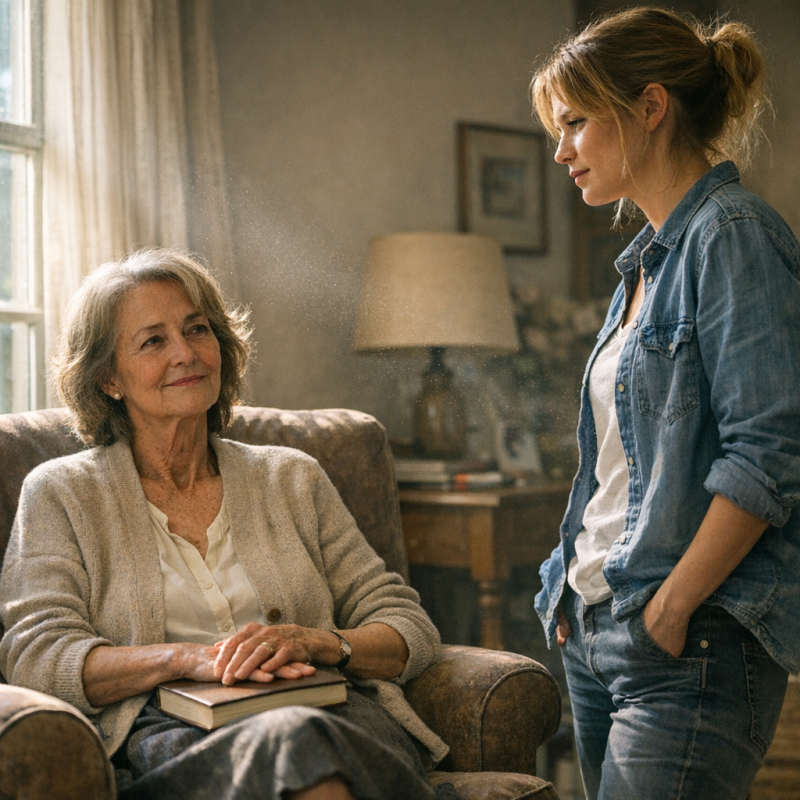 Image by FCT AI
Lorraine's Justification
She continued as if we were discussing the weather. 'Rachel was weak. She couldn't handle the reality of being with Daniel—that I'm part of the package. That family comes first.' Her voice was matter-of-fact, completely devoid of shame. 'I needed to know if you were different. If you had a spine.' I stared at her, genuinely unable to process what I was hearing. 'You destroyed his engagement,' I said. 'You've controlled his entire life. And you think that's... acceptable?' Lorraine waved a hand dismissively. 'I protected him from making a terrible mistake. Rachel would have isolated him from his family. From me. She was already trying to move him across the country.' She leaned forward slightly. 'But you—you fought back. You set boundaries. You didn't crumble under pressure. That's what Daniel needs. Someone strong enough to stand up to me, because God knows he never could.' The twisted logic was breathtaking. She'd put us both through pure agony and was framing it as some kind of favor. Some kind of service. She said Daniel's ex-fiancée wasn't—and she was glad I was.
 Image by FCT AI
Daniel's Choice
Daniel appeared in the doorway. I don't know how long he'd been standing there, but from the look on his face, he'd heard enough. 'Mom.' His voice was quiet but there was something new in it. Something I'd never heard before. Lorraine turned to him with her usual warm smile, the one that had manipulated him for thirty-seven years. 'Daniel, sweetheart, your wife and I were just having a conversation about—' 'I heard you,' he interrupted. He walked into the room and stood beside me. His hands were shaking but his voice stayed steady. 'I heard what you said about Rachel. About testing her. About testing us.' Lorraine's smile didn't waver. 'Darling, you have to understand—' 'No.' The single word cut through the room. 'You don't get to do this anymore. You don't get to engineer crises and manufacture emergencies and manipulate everyone around you. You don't get to decide who's strong enough or worthy enough or good enough. That ends today.' Lorraine's face changed then. The mask slipped. 'Daniel, I'm your mother—' He looked at her and said, 'This stops now.'
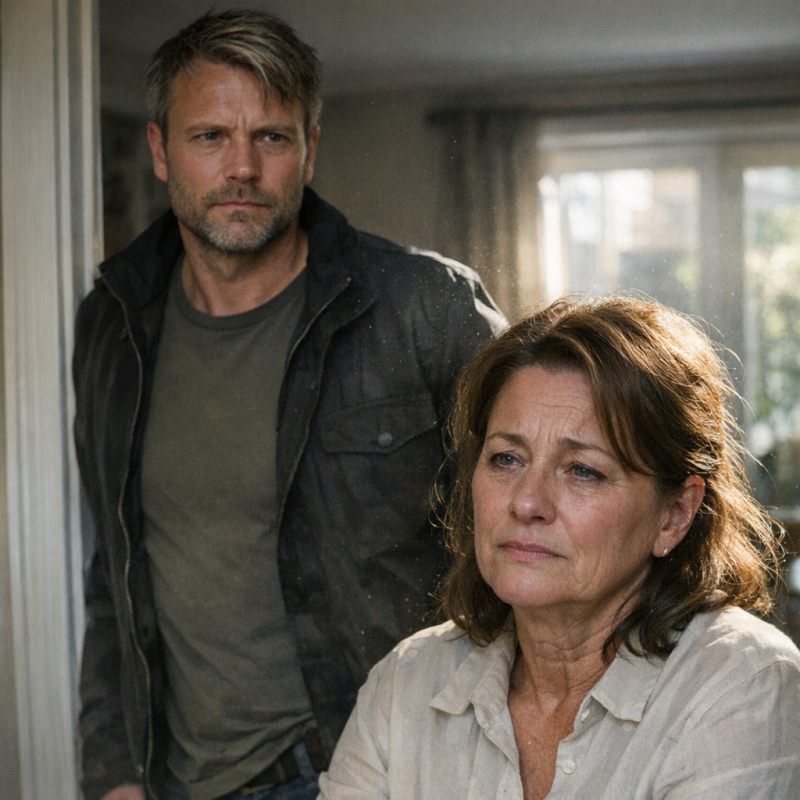 Image by FCT AI
Setting the Terms
We laid it all out that afternoon. The three of us sat at the dining table like we were negotiating a business contract—which, in a way, we were. Daniel did most of the talking. I watched decades of conditioning fight against his resolve with every sentence. 'You can stay here,' he said. 'But Carla makes all care decisions. She's here as your aide, not as someone you can dismiss when you don't like her recommendations. We'll make medical appointments based on doctor's advice, not on feelings. And you don't comment on how we run our household. Not our schedule, not our choices, not our relationship.' Lorraine listened with a perfectly composed expression. When he finished, she was quiet for a long moment. I expected resistance. Another manufactured health crisis. Tears. Manipulation. Instead, she simply nodded. 'If those are the terms, I accept them,' she said calmly. Too calmly. Daniel relaxed slightly, but I kept watching her face. 'I'm glad we could come to an understanding,' Lorraine added, her tone pleasant and reasonable. She agreed—but I could see the calculation in her eyes.
 Image by FCT AI
The Uneasy Truce
The next few weeks were strange. Lorraine followed the new rules precisely. She was pleasant with Carla, who returned to her regular schedule. She didn't comment when Daniel and I went out for the evening. She attended her medical appointments without drama. On the surface, everything had changed. But I couldn't shake the feeling of walking on ice, waiting for the crack. Daniel seemed lighter, though. He'd started therapy—individual sessions to work through what he was calling 'a lifetime of unhealthy patterns.' He apologized to me more than once for not seeing it sooner, for not protecting me better. I told him we'd both been in it, both learning. Carla, perceptive as always, picked up on the shift immediately. 'Whatever happened,' she said to me quietly one morning, 'it needed to happen.' The household had a rhythm now, clear boundaries and defined roles. But every time I passed Lorraine reading in her chair or heard her cheerful good morning, I remembered that cold satisfaction in her eyes. We had won the battle—but the conflict felt far from over.
 Image by FCT AI
Lorraine's Apology — Sort Of
Three weeks after our confrontation, Lorraine asked to speak with me privately. My guard went up immediately, but I agreed. We sat in the living room, the same room where she'd admitted her manipulation so casually. 'I've been thinking,' she began, her hands folded in her lap. 'About what happened. What I did.' I waited, saying nothing. 'I may have... pushed too hard. With you and with Rachel before you. My methods were perhaps more extreme than necessary.' It wasn't quite an apology. The words were careful, calculated. 'But you have to understand,' she continued, 'everything I did came from a place of love. Of wanting to protect my son from making mistakes.' There it was—the justification, the reframing. She couldn't just apologize. Couldn't just admit she'd been wrong. I looked at her steadily. 'I understand that you believe that,' I said. She studied my face for a long moment, and something like respect flickered across her features. She said, 'You're stronger than I expected'—and I wasn't sure if that was praise or warning.
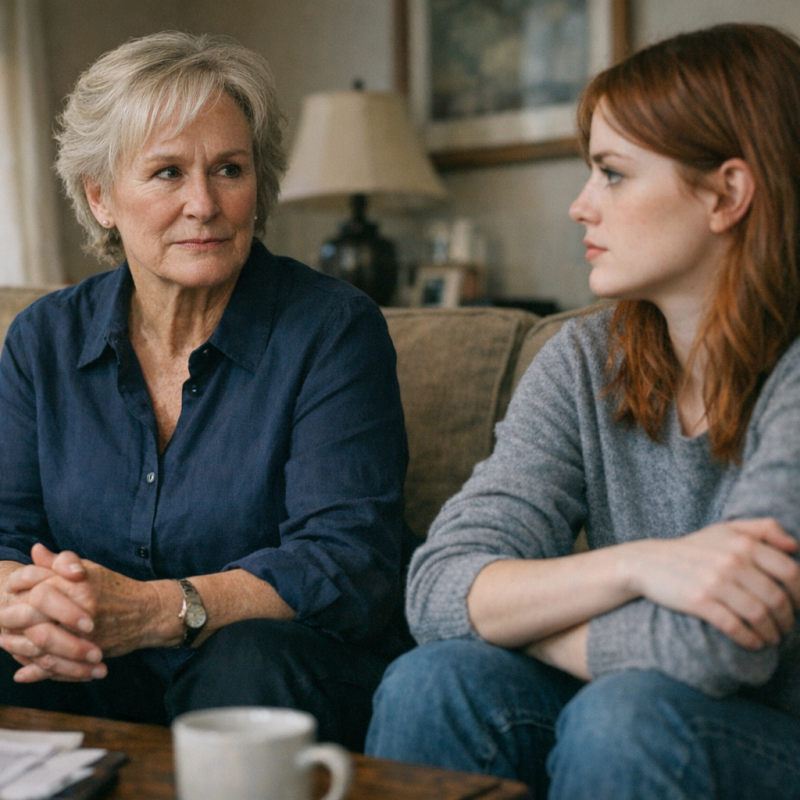 Image by FCT AI
Daniel's Growth
A week after that conversation with Lorraine, Daniel came home with a business card. 'I found a therapist,' he said, setting it on the counter between us. 'Someone who specializes in family dynamics. I made an appointment for next Tuesday.' I picked up the card, turning it over in my hands. I'd suggested therapy months ago, back when everything was falling apart, but he hadn't been ready then. 'What changed?' I asked. He looked at me with an honesty I hadn't seen in a long time. 'You did. You set boundaries when I couldn't. You protected yourself when I failed to protect us.' His voice cracked slightly. 'And I realized I don't know how to do this—how to be a partner instead of just reacting to whatever my mother needs.' Over the following weeks, I watched him go to those sessions. He came home quieter sometimes, processing things he'd never questioned before. One evening, as we sat together after dinner, he reached for my hand. 'I need to learn how to be a husband, not just a son.'
 Image by FCT AI
The New Normal
Six months later, our household had found its rhythm. Carla arrived each morning at nine, and Lorraine had stopped treating her like an intruder. They'd developed their own rapport—professional but warm. Lorraine had her routines, her space, her independence. Daniel and I had ours. Sunday dinners were still tense occasionally, but the explosions had stopped. Lorraine no longer ambushed me with criticisms or tried to rearrange my kitchen. When she had an opinion, she voiced it once, then let it go. Daniel had learned to notice when she was manipulating, and he'd started calling it out gently but firmly. 'Mom, that's not fair,' he'd say, and she'd retreat. I'd learned to speak up before resentment built, to say 'no' without guilt consuming me afterward. Carla became more than hired help—she became a buffer, yes, but also a witness. Her presence reminded everyone we'd made agreements, established boundaries. The house no longer felt like a battleground. It wasn't perfect—but it was sustainable.
 Image by FCT AI
Reflections on Boundaries
Looking back now, I can see how close I came to disappearing completely. For months, I'd absorbed every criticism, swallowed every frustration, convinced myself that keeping the peace was worth the cost. I'd stopped voicing opinions. Stopped taking up space. Stopped recognizing my own needs as legitimate. That's what happens when you're told, over and over, that you're not enough—you start to believe it. You start to shrink. I learned that boundaries aren't cruel. They're oxygen. They're the difference between surviving and suffocating. I learned that silence isn't peacekeeping—it's self-abandonment. Every time I stayed quiet when Lorraine criticized me, every time I let Daniel's inaction slide, I was teaching them that I didn't matter. And they believed me. Why wouldn't they? I believed it too. The hardest lesson was this: you can't control how people react to your boundaries, but you can control whether you enforce them. I had almost lost myself trying to keep the peace—but I chose myself instead.
 Image by FCT AI
The One Important Detail
So here's the thing everyone wanted to know from the beginning: what was the one important detail I left out when I agreed to let my mother-in-law move in? It wasn't just hiring Carla, though that was part of it. It wasn't just setting boundaries or demanding change, though those mattered too. The detail I left out was this: I decided I mattered enough to save. I decided that my peace, my mental health, my sense of self were worth fighting for—even if it meant conflict, even if it meant disappointing people, even if it meant risking my marriage. When Lorraine announced she was moving in, she expected me to fade into the background, to become invisible, to serve without complaint. And for a while, I almost did. But somewhere in the middle of that nightmare, I remembered who I was before I started shrinking. I remembered I deserved to take up space in my own home. My mother-in-law declared she was moving in, expecting me to disappear. I agreed—and found myself instead.
 Image by FCT AI