 Eliano Imperato/Anadolu, Getty Images
Every so often, Pompeii pulls back another layer and reminds us how much of the ancient world is still waiting to be seen. That feeling returned when archaeologists stepped into a newly exposed room and realized the walls were alive with color and myth. A nearly life-size procession had survived beneath the ash. The discovery adds a new chapter that began more than a century ago with the famous Villa of the Mysteries. The figures feel startlingly present, almost as if they had been waiting for someone to walk in and witness their ritual. Their scale and movement make the room feel like a stage set for a ceremony that never finished.
A Banqueting Room Built For Ritual And Spectacle
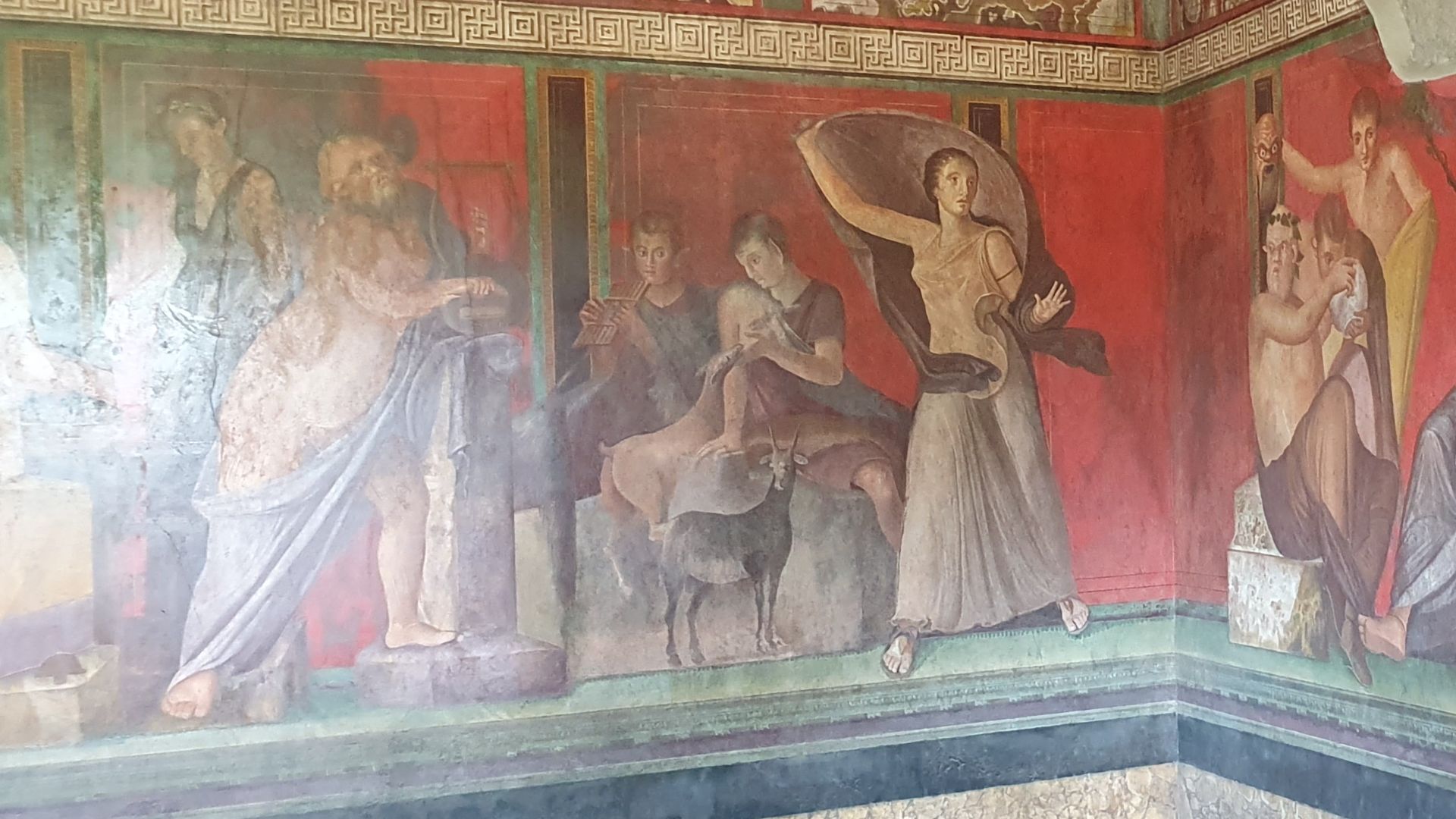
The fresco belongs to a spacious banqueting room recently excavated in Insula 10 of Region IX. Its scale creates an immediate sense of ceremony. Three walls carry a continuous frieze, while the fourth side once opened into a garden where guests likely stepped out for air during long dinners. The frieze itself is a megalography, a term for large paintings that feature figures nearly at human height. Here, the effect is almost theatrical, as if visitors were meant to feel surrounded by the world of Dionysus, a god known for death, rebirth, and the promise of transformation. The painted scene unfolds as a Dionysian procession, starting with bacchantes—female followers of Dionysus—shown shifting between ecstatic dance and wild hunting.
Around them move young satyrs with pointed ears. Some play the double flute. One performs a dramatic libation, a ritual pouring of a liquid (like wine, milk, or water) as an offering. He bends his body so sharply that the wine shoots backward from a drinking horn into a shallow bowl behind him. At the center of the room stands a woman guided by an old Silenus who carries a torch. She is portrayed not as a follower but as an initiate. Her presence hints at the secretive rites of Dionysus. In the ancient world, those who completed his nocturnal rituals believed they were granted a new destiny in this life and the next.
A Rare Look Inside The Mysteries
The residence has been named the House of Thiasus, a reference to the Dionysiac world—the cultural sphere shaped by devotion to Dionysus. In antiquity, a thiasus was both a group of worshippers and the ritual performance they enacted. The room’s decoration signals that the owner embraced the world of mystery cults, which were private religious groups that restricted knowledge to those who completed specific rites. These groups promised not only divine favor but also a hopeful afterlife. The fresco can be dated to the 40s and 30s BC. That places it in the Second Style of Pompeian painting. It also means that the artwork was already a century old when Vesuvius, the volcano that buried Pompeii, erupted in AD 79.
Since only a handful of paintings tied to mystery rites survive, scholars often set this cycle alongside the famous Mystery frieze in the Villa of the Mysteries outside Pompeii’s walls. Both show a woman caught between two versions of feminine identity. On one side stands the devoted, orderly figure of Venus. On the other stands the bacchante who abandons social roles and follows Dionysus into the wild. The woman in the House of Thiasus seems suspended between these two extremes. A second frieze appears above the larger one. It depicts animals both living and dead, including a fawn, a freshly gutted wild boar, cockerels, sea creatures, and various birds.
Why The Discovery Matters Today
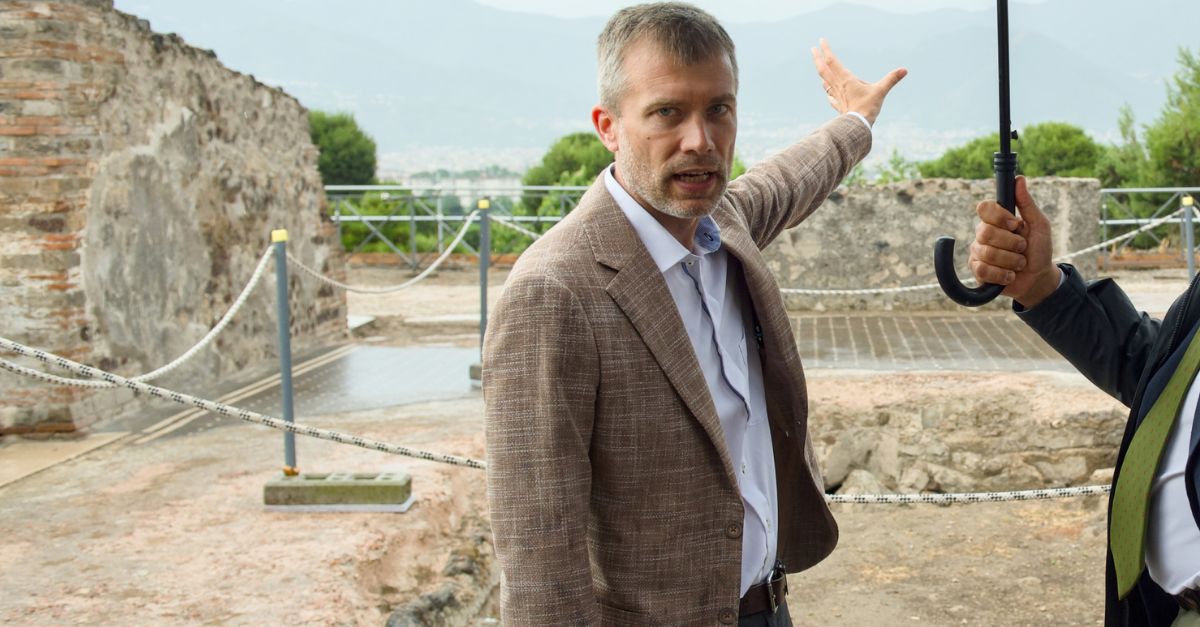
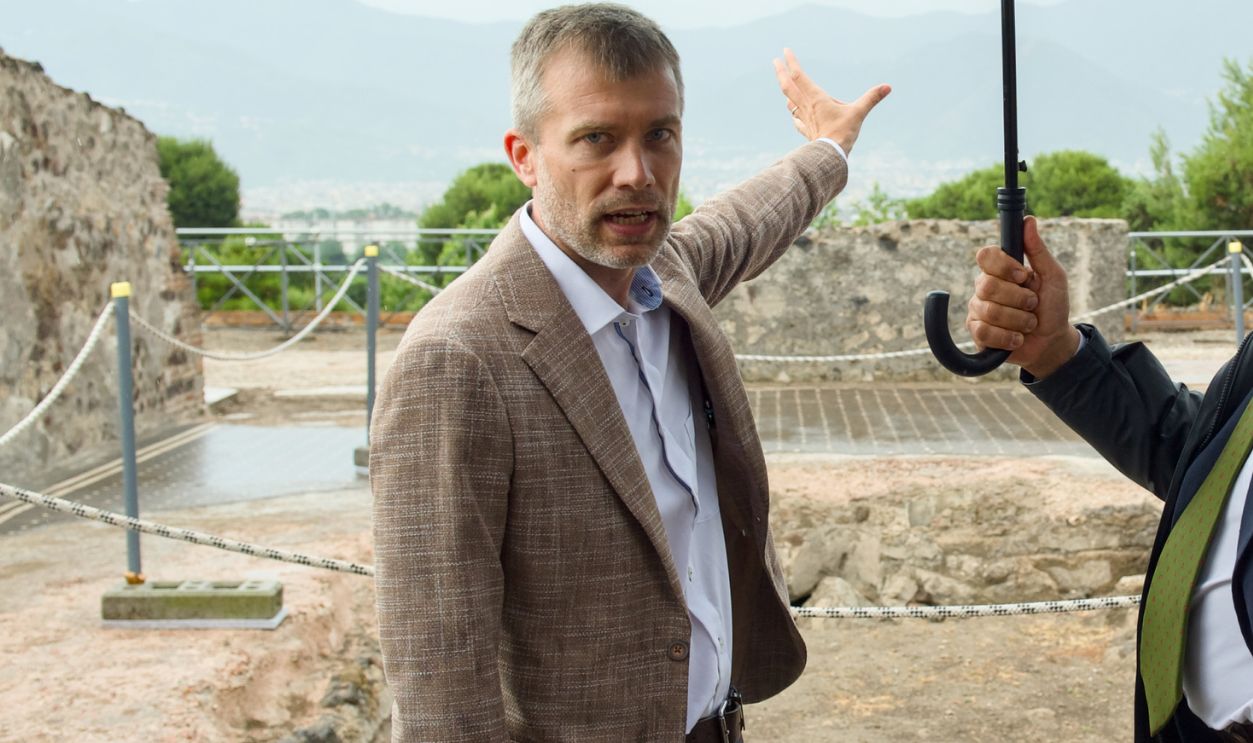
Italian officials have called the discovery historic, noting that it offers another viewpoint on the rituals of Dionysus. The Minister of Culture described it as an exceptional document that enriches what we know about life in the classical Mediterranean. Gabriel Zuchtriegel, director of the Archaeological Park, points out that the hunt of the bacchantes appears in ancient literature as a metaphor for ecstatic living. Euripides, one of the three great Athenian tragedians known for probing the emotional and psychological lives of mythic figures, explored the theme in his tragedy “Bacchae,” written in 405 BC.
Zuchtriegel adds that the fresco also hints at a broader religious shift in the ancient world. Behind the dramatic figures lies a sense of spiritual searching that reaches back to earlier cultures in the Aegean. Dionysus himself was worshipped by the Mycenaeans, the Bronze Age Greek civilization that dominated the mainland. He was also revered by the Cretans, the people of Minoan Crete, whose religion left a rich artistic record, under the name Zagreus, a lord of wild animals. The House of Thiasus shows how private homes once carried intense symbolic meaning, leaving us with a rare reminder of how deeply spirituality shaped life in the ancient Mediterranean.
 Yair Haklai, Wikimedia Commons