
You’ve heard it a thousand times—“To thine own self be true”. This line sounds noble, almost timeless, and it’s printed on graduation cards, embroidered on pillows, and quoted as proof that Shakespeare believed in personal authenticity.
But here’s the twist: that line doesn’t come from a sage hero or philosopher. It’s delivered by Polonius, a meddling courtier in Hamlet, giving a rambling, shallow lecture to his son before sending him off to college. In context, it’s less about honesty and more about hypocrisy. Once you see who said it—and how he lived—you may never look at the quote the same way again.
The Real Source: A Lecture, Not Wisdom
In Hamlet Act 1, Scene 3, Polonius offers a string of parental platitudes to his son Laertes, capped by “This above all: to thine own self be true”. He tells Laertes not to borrow or lend money, to dress well, and to avoid quarrels—a collection of empty-sounding advice more suited to a pompous uncle than a wise mentor. Scholars point out that Shakespeare deliberately made the speech sound pompous, filled with cliches his Elizabethan audience would have recognized as trite. The line was written to mock.
Polonius’s character only reinforces that interpretation. He’s portrayed as verbose and intrusive—someone who values reputation over morality. In later scenes, he spies on his own son and uses his daughter Ophelia to manipulate Hamlet. Later, he hides behind curtains to eavesdrop, leading to his own death. The irony couldn’t be sharper: a man who lectures others about integrity behaves deceitfully at every turn.
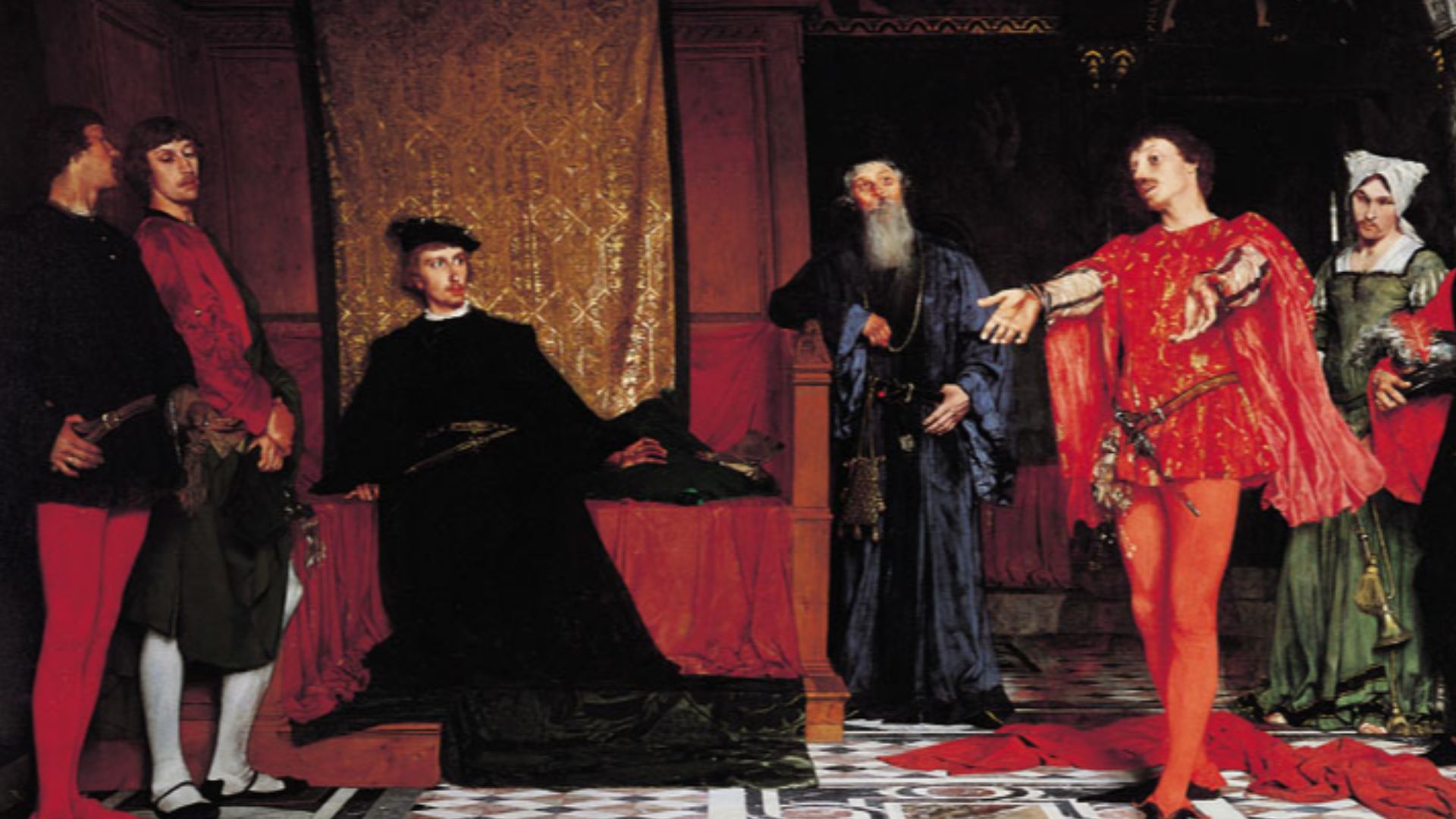 Wladyslaw Czachorski, Wikimedia Commons
How A Mocking Line Became A Moral Mantra
Centuries later, the irony got lost. As Shakespeare’s phrases filtered into common speech, people lifted “to thine own self be true” out of Hamlet and stripped it of its context. By the 19th and 20th centuries, it was quoted in sermons, psychology texts, and even advertisements as a slogan for self-fulfillment and confidence.
What began as satire turned into inspiration. That shift reveals how culture often reshapes art to suit modern needs—turning a cynical line from a hypocrite into a feel-good piece of wisdom.
It’s easy to see why. The phrase rolls off the tongue and promises simplicity: just be yourself. But Shakespeare’s point wasn’t that easy. The Bard knew people rarely see their own hypocrisy. Polonius believed he was wise, but audiences knew better. That disconnect between self-perception and reality is what Shakespeare was skewering.

What You Can Take From The Real Context
Instead of tossing the quote aside, it’s worth reclaiming it with a clearer understanding. When Polonius says, “To thine own self be true,” he unintentionally exposes a human flaw—the gap between what we preach and what we practice. The line invites reflection: how often do people disguise self-interest as virtue? How many “truths” are convenient rather than honest?
So, the next time you hear that line on a coffee mug or in a commencement speech, smile—and remember the irony. Shakespeare didn’t give us a rule to live by; he gave us a mirror to examine ourselves.