Development work in Heilbronn’s Neckargartach district revealed a striking archaeological surprise when teams uncovered a 500-meter Roman road, a roadside settlement, and a temple dedicated to Mercury beneath the modern land. The discovery emerged during preparations for a new AI campus, prompting a large-scale excavation that exposed features preserved for nearly 2,000 years. The findings confirm that the road once connected Roman military centers in the region and that the adjoining settlement likely supported travelers and activity along this important route. The discovery offers a rare look at how infrastructure, commerce, and religion functioned together during the Roman presence in southern Germany.
A 500-Meter Roman Road Comes To Light
Archaeologists uncovered a 500-meter stretch of a Roman road in Neckargartach that remained hidden beneath fields and farm paths. Its straight alignment and considerable width point to its role as a heavily trafficked connector between Roman sites in the region. The discovery also showed that sections followed the same lines as later agricultural routes, helping preserve the ancient roadway until excavation began for the new development. This alignment allowed specialists to expose a continuous portion long enough to study construction details and understand how the road functioned as part of a larger transport network.
Preserved for nearly two millennia, this stretch of roadway offers a rare window into how Roman engineers shaped movement across the region. Instead of relying on improvisation, builders created a corridor sturdy enough to lead heavy traffic between military and civilian sites. Travelers, merchants, and officials would have followed its firm surface as they moved through frontier territory, linking settlements that depended on predictable routes. Careful adaptation to the surrounding land becomes clear in the surviving structure, showing how road crews balanced durability with terrain. Such details reveal how transportation supported communication, trade, and administration throughout this part of the Roman world.
Life Around The Roadside Settlement
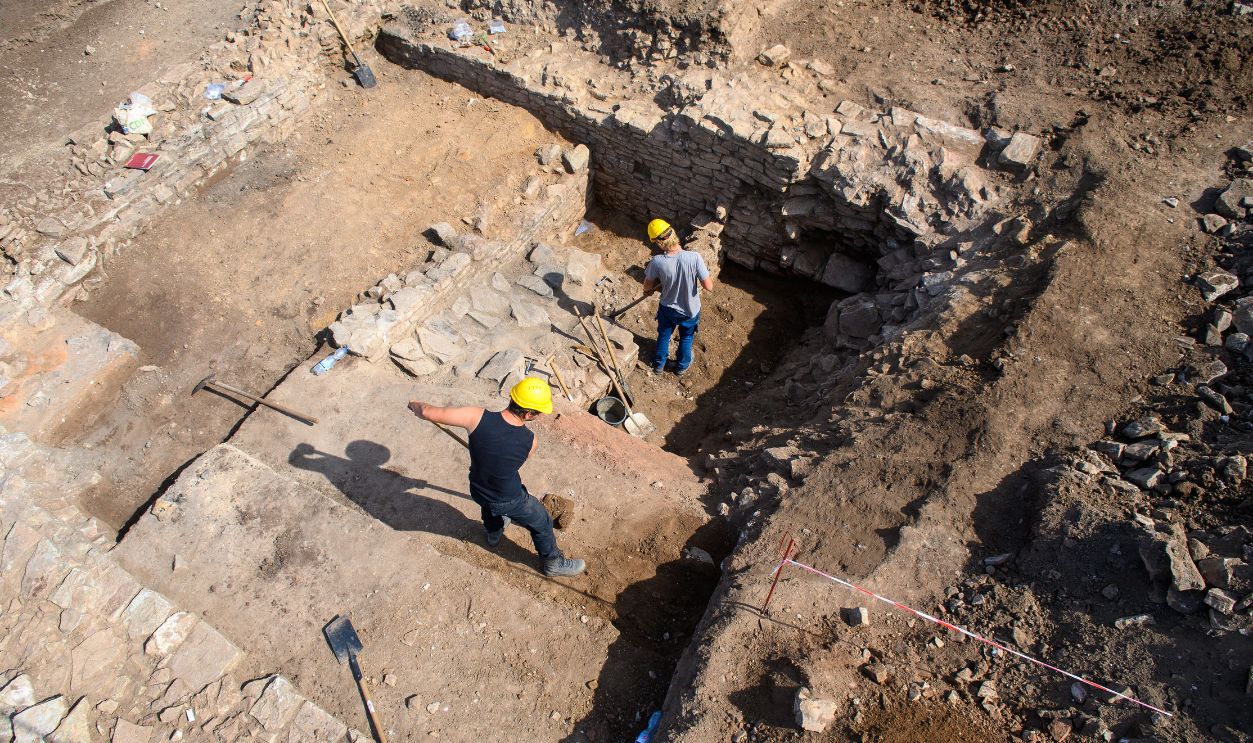
Excavations revealed a settlement positioned directly along the road, interpreted as a roadside community rather than a single estate. This conclusion emerged once archaeologists identified multiple structural features instead of one unified building. Its location suggests active engagement with the regular flow of people who passed through the region. Roadside settlements like this typically supported trade, short-term lodging, small workshops, and services needed by travelers. The distribution of features showed that the area functioned as a lively stop rather than an isolated farm, highlighting how infrastructure influenced settlement patterns.
Cellars, foundation traces, and work areas point to steady activity within the roadside community. Instead of a single villa complex, the spread of features revealed a cluster of structures tied directly to the traffic moving along the Roman road. Patterns in the layout hint at people responding to a steady flow of travelers, creating spaces for work and interaction. Activity here depended on movement beyond the settlement itself, linking residents to wider regional networks. Evidence from the excavation underscores how road corridors nurtured small hubs of commerce and labor and supported daily life even in areas far removed from larger Roman towns.
A Long-Hidden Temple To Mercury
The remains of a small temple dedicated to Mercury stood out as one of the most striking discoveries at the site. Sculptural fragments—including pieces of a statue identifiable by the god’s characteristic attributes—allowed archaeologists to recognize the building as a sanctuary. Mercury’s association with commerce, guidance, and travel makes his presence especially meaningful at a location positioned beside a major road. The temple’s placement suggests that travelers may have paused there for protection, thanks, or ritual observance as they moved between Roman centers. Its location strengthens the view that the surrounding settlement served both practical and symbolic roles along the route.
Material inside the structure clarified the sanctuary’s function and tied it directly to the activity surrounding the road. Positioned beside the settlement, the temple occupied a point where movement, exchange, and belief intersected in a practical, everyday setting. Travelers heading between Roman centers would have encountered it as part of their routine passage, turning a simple route into an experience shaped by acknowledgment of a guiding deity. Its presence signaled assurance as well as intention and marked the road as a space with meaning beyond transport. By revealing this final element, the discovery brings the entire site into sharper focus and underscores how multiple purposes operated side by side in Roman life.