Until There’s Nothing Left
Trapped in the close confines of the city of Stalingrad, Germany and the Soviet Union grappled for control. They were two groups famed for their fierceness and determination—and neither side expressed a willingness to admit defeat. They would hold onto the city or perish in the attempt. This was the Battle of Stalingrad.
When the dust settled, it revealed losses so high that the question remains: Did anyone really come out ahead?
1. It Marked The Beginning of The End
By 1942, conflict was raging across Europe, tearing countries apart for years. Germany’s forces had made rapid movement west, capturing France two years earlier. Meeting fierce opposition across the channel, stalling their westward movement, they began looking in the other direction, officially dividing the conflict into two fronts (Eastern and Western) with “Operation Barbarossa”.
This proved to be their first mistake of many.
2. It Followed Great Failure
By 1942, another thing had raged untamed for three years: Germany’s ego. With Operation Barbarossa, they believed they could trample through the Soviet Union as they had through Western Europe. Instead, Operation Barbarossa pushed them to their limits, burning through resources and men, leaving Germany in desperate need of a victory.
3. It Never Should’ve Happened
As the spring of 1942 wore on, both the German Chancelor and Soviet Prime Minister Joseph Stalin began looking forward. They planned, anticipating renewed conflict as summer allowed the Russians to finally thaw. Stalin reallocated his forces toward Moscow, convinced Germany would target the capital.
Well, Germany’s leader had another plan in mind.
4. It Wasn’t Part Of The Plan
Germany desperately needed oil if it wished to keep their machines of destruction moving. This forced them to send their men south, away from Moscow and towards the Caucasus, where the Russians held oil fields in Azerbaijan that had the black gold they desperately needed. This sent them on a direct path to another city that, ironically, Stalin forgot about entirely.
5. It Was An After Thought
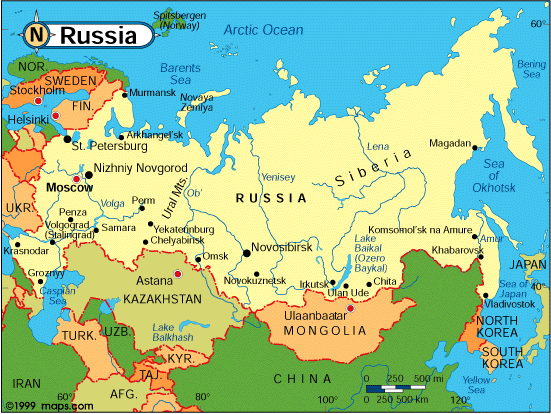
Germany needed oil to fuel their ongoing efforts. Their leader wanted Stalingrad. Strategically, Stalingrad guarded the key to controlling the Soviet Union as it sat upon one of its largest water ports. The longest river in Europe, the Volga, connected the Soviet Union.
Control the Volga, and you control the land. Yet, Stalingrad represented far more than control; it represented victory.
6. It Was About Propoganda
As you likely already put together, Stalingrad bore the name of the Soviet leader: Joseph Stalin. Conquering Stalingrad unlocked a whole new level of psychological attack through propaganda. If the Germans could flatten Stalingrad, then they could flatten Stalin—literally.
Germany had Stalingrad in their sights, and if it got what it wanted, no one would survive.
7. It Was Meant To Annihilate
Germany made their plan clear, right down to the top. Their infamous leader had one intention for Stalingrad: complete and total annihilation. Every male in Stalingrad would have their life ended once the Germans entered. As for the woman and children, they’d be “removed”. Germany intended to level Stalingrad and remake it in their image, and the Soviets had their eyes somewhere else.
8. It Began With A Split
The Germans began their movement into Russia in May 1942. Under the instructions of their leader, they split their men. Half moved south towards the much-needed oil, while the rest pushed forward with only one destination in mind: Stalingrad. By the end of July, Stalin realized his mistake.
Moscow was safe—because the Germans were knocking on Stalingrad’s door.
9. It Was In Their Sights
German forces arrived at the Don River by the end of July 1942. They chose their path correctly, as their stronghold on the Don sat a mere 40 miles away from the river they actually wanted. Only one thing stood between them and the Volga now: Stalingrad. As the Germans prepared to push forward, the Soviets scrambled to catch up.
10. It Forced Them To Scramble
Realizing his mistake, Stalin scrambled to reallocate his men to defend the city. Everyone understood the mission: defend Stalingrad regardless of the costs. Lieutenant General Vasiliy Chuikov bravely claimed, “We will defend the city or die in the attempt”. His words proved darkly prophetic.

11. It Proved A Bigger Challenge Than Imagined
If Germany thought that it would take Stalingrad with ease, then they learned nothing from their previous skirmish with the Soviets. Despite failing to anticipate the attack, the Soviets met the Germans at the Don River with everything that they had—they were defending their homeland, and it showed in the intensity of battle.
12. It Started With Smaller Battles
Before the Battle of Stalingrad, the Germans and Soviets fought the Battle of Kalach. Although they developed their counterattack in haste, leading to poor planning and ultimately the loss of over 200,000 men, the Battle of Kalach showed the Germans exactly what they were up against. They just refused to listen.
13. It Had Two Strong Opponents
Although the Germans ultimately won at Kalach, they left “numerous burnt-out or shot-up German tanks” behind, proving that the Soviets gave as good as they got. Germany fought for greed; the Soviets fought for their country. This battle and several others indicated just what Germany was in for, and yet they continued forward, blindly believing they had the strength to take whatever they wanted.
14. It Was Inevitable
Despite the Soviets’ valiant efforts north of the city, the Germans arrived on the outskirts of Stalingrad by August 23. Seeing the writing on the wall, Stalingrad began to prepare to defend its city. They sent valuable materials such as grain and cattle out of the city, winning a small “harvest victory”…and dooming themselves in the process.
15. It Forced Them To Take Drastic Measures
The Soviets succeeded in removing potential food sources from the Germans’ grasp, but they cut themselves off from the same resources in the process. By sending out essentials like grain and cattle, Stalingrad found itself short on food before the invasion even started. Now, they had nothing left to do but wait for the Germans to make their move.
16. It Started With Destruction
Before their advance on Stalingrad, the Germans had poured all of their resources into ensuring they cut the city off from all external forces. They cut off shipping on the Volga, sinking 32 Soviet vessels in the span of a week. Yet, even this prelude proved nothing compared to the main show.
17. It Changed Everything
Life changed forever for the citizens of Stalingrad on August 23, 1942. Up until this point, the Germans had merely been playing with the Soviets. They initiated their advance on the city by dropping 1,000 tons of explosives upon Stalingrad, where thousands of civilians remained in the line of fire.
18. It Held Civilians Captive
The civilians of Stalingrad remained in the city, despite the advancing Germans. Instead of fleeing to safety, they were put to work, digging trenches and building other fortifications designed to protect the city. Neither bravery nor German pressure entreated them to stay. No, the very people meant to protect them trapped them instead.
19. It Showed The Dark Side Of Men
The story goes that Stalin refused to allow the civilians to leave Stalingrad, despite the obvious danger creeping closer and closer. Supposedly, he believed that the presence of civilians within the city would provide those fighting with a stronger motivation to defend at all costs. Unfortunately, it’s hard to defend against 1,000 tons of firepower.
20. It Made History In The Worst Way
The German air raid that opened the Battle of Stalingrad was “the heaviest bombing raid that had ever taken place on the Eastern Front”. As a result, it left endless casualties in its wake. Initial reports indicate that almost 1,000 people lost their lives between August 23 and 26. However, that number’s been thrown into question many times over.
21. It Is Hard To Track Loss Of Life
Over the years, estimates of the loss of life following this opening attack have varied and exaggerated. It’s been said that anywhere from 955–70,000 perished, with another 1,181–150,000 wounded. While many often doubt the larger numbers as exaggerations, no one doubts the devastation caused, and the Germans were only getting started.
22. It Came In Waves
Later that same day, once the sounds of explosions had quieted, something far worse marched through the smoke and rubble into the city. Once satisfied with the destruction their planes had created, the Germans unleashed their vehicles of conflict. The time for preparation was over; the battle had begun.
23. It Brought Out Extremes In Everyone
The Germans announced their presence with extreme force. Over 320 tanks and armored personnel carriers rolled into the city of Stalingrad, breaking through the Soviets’ early defense blocks until they arrived in the northern suburbs of the city. They’d reached their destination, but the Soviets weren’t about to hand it over without a fight.
24. It Started In the Suburbs
In Latashanka, one of Stalingrad’s northern suburbs, the Germans met the 1077th Anti-Aircraft group. Although this group primarily consisted of men, the Soviets did something most others didn’t at the time. They built up their army with men and women.
The women of the 1077th proved that they could give just as much as men—and maybe even more.
25. It Was Worse Than Imagined
This area saw intense fighting immediately. One woman who’d fought recalled, “I had been imagining what war was like—everything on fire, children crying, cats running about, and when we got to Stalingrad it turned out to be really like that, only more terrible”. To make matters worse, this was only day one.
26. It Showed What People Were Made Of
The people of Stalingrad truly proved what the Soviets were made of. The Germans faced opposition from every person they crossed. The ministry pulled together hastily clad groups of civilians to create groups to defend against the invading Germans. Unfortunately, these groups may have had spunk—but nothing to defend themselves with.
27. It Forced Everyone To Fight
Many of these civilian groups lacked anything close to a weapon; they’d be sent against fully armed Germans without a single weapon of their own. While a “tank destroyer” unit from the local university technically rolled out in “tanks”, these machines were a pale comparison to what the Germans were rolling in on.
28. It Didn’t Prepare People Well
University students and staff made up the unofficial unit. They assembled their tanks from scraps abandoned in the nearby tractor factory; they were only effective if fired at point-blank range. It’s unsurprising that under these conditions, the men and women heading into battle quickly realized the destruction that they faced bore no resemblance to anything on earth.
29. It’s Horror Was Felt By All
Initially, fighters claimed, “We are entering hell” when approaching the boiling pen that the city had become thanks to the Battle of Stalingrad. However, after only a day or two, they realized their mistake. They’d change their tune, “No, this isn't hell, this is ten times worse than hell”. Whether a fiery afterlife or worse, it didn’t matter. They had no escape.
30. It Trapped Men In Place
Retreat was not an option, quite literally. At the end of July, Stalin made a bold declaration with regards to the Battle of Stalingrad. Any commander who ordered a retreat from Stalingrad without authorization from above would face tribunals. Of course, when faced with horrors, men will make their own decisions. The ministry had prepared for this as well.
31. It Didn’t Let Anyone Flee
Stalin and his government made sure that no one could leave Stalingrad. His people would, literally, defend the city or perish trying. He had men set up behind the defense line that his people held within the city. Any men who attempted to flee fled right into the arms of these battalions and faced the consequences for it.
32. It Showed Extremes From All Sides
From the start of the Battle of Stalingrad in August until the middle of October, these “blocking parties” captured 51,758 men attempting to flee the horror of Stalingrad. These men saw no mercy. The powers-that-be executed 980 deserters and sent another 1,349 to penal companies. The only saving grace the Soviets had was that the Germans faced the horror along with them.
33. It Was Worse Than Anything Before
A letter found upon the body of a German officer showed the horror of the Battle of Stalingrad, highlighting just what the Germans faced. He wrote, “We must reach the Volga. We can see it—less than a kilometer away. […] The whole war for France was shorter than the fight for one Volga factory”. The Germans didn’t realize just what the Soviets would do to protect their city.
34. It Was Fought By Passionate Men
Stalingrad became the place where two forces refused to relinquish control. The same officer concluded his statement with, “We must be up against suicide squads. They have simply decided to fight to the last soldier. … When will this [nightmare] come to an end?” Neither Germany nor the Soviets gave in, and as a result, Stalingrad became unrecognizable.
35. It Left Unimaginable Devastation
Another German commander noted in his journal, “The street is no longer measured by meters but by corpses…Stalingrad is no longer a town”. He went on to describe the Battle of Stalingrad as a nightmare shrouded in fire and destruction, concluding his entry with, “Animals flee this [horror]; the hardest stones cannot bear it for long; only men endure”. Though what exactly were the men enduring for?
36. It Inspired Impassioned Fighting
The Germans did not anticipate the opposition that they faced in Stalingrad. As stated by yet another German, “A bitter battle for every house, workshop, water tower, railway embankment, wall, cellar, and every pile of rubble was waged, without equal even in [WWI]”. Yet, despite the Soviets’ determination, they could only delay the inevitable.
37. It Made Heros Out Of People
Two famous battles in the first stage of the Battle of Stalingrad were for a giant grain elevator and a four-story building. Each a meaningless space before the battle, yet small groups of Soviets turned these areas into strongholds, forcing the Germans to fight to the bitter end if they wanted to take this small inch of land. In each battle, the Soviets forced the Germans to diminish their numbers and slowed their march forward. Yet, it did not stop them.
38. It Didn’t End With The Volga
In the end, the Germans reached the Volga and the south of the city. However, the Soviets continued to hold them from what they really wanted. They still controlled the ferries and, therefore, the city. If the Germans wished to truly take Stalingrad, then they had to deal with the “final boss” lurking in the northern industrial district.
39. It Changed Directions
In the north of Stalingrad sat the city's industrial district and three large looming factories: the Red October Steel Factory, the Barrikady Arms Factory, and the Stalingrad Tractor Factory. The Germans repeated their previous attack pattern, leading with a steady stream of shelling, but they’d failed to account for what the Soviets had turned these factories into.
40. It Created Fortresses
The factories were large, looming buildings. The Soviets had had weeks to anticipate the oncoming advance as the Germans crawled their way through the south of the city. As a result, by the time they reached the factories, the Soviets had turned them into looming fortresses that they would defend with their very lives if they had to.
41. It’s Fighting Was Brutal
The factories possessed endless places for the Soviets to hide, creating a series of “traps” that the Germans had to fight their way through. This led to a particularly intense and brutal period of fighting that centered around this concentrated area around the three factories. The Germans gained the control they desired, but they paid a high price for it—perhaps too high a price.
.jpg)
42. It Blinded The Germans
The Germans put so much energy into taking the plants that they forgot what their true aim had been in the Battle of Stalingrad. To keep constant air raids going over the city, they’d been forced to pull more and more power from the southern oil fields, which had supposedly been their main goal. They’d also forgotten about fortifying their defenses around the city.
43. It Made The Germans Forget
As winter began to fall, the Soviets got their first chance to take back some of their land and begin changing the tides. Germany and their Axis powers neglected their defense lines outside of the city, instead sending all their manpower into the city. This gave the Soviets the opportunity that they needed—and sealed the fate of the Germans.

44. It Gave The Soviets An Opportunity
By November 10, the Soviets had reclaimed all of the land surrounding Stalingrad, leaving those who were still in the city in a desperate situation. Roughly 210,000 Germans now found themselves trapped within Stalingrad, surrounded by enemies on all sides. Like the Soviets before them, the trapped Germans became the scapegoat of their leader’s pride.
45. It Was Lost
Despite months of desperate fighting, it became clear that they’d lost the Battle of Stalingrad. Yet their Chancellor refused to admit to the failure. Germany’s Friedrich Paulus and his 6th Army were within the city, and thanks to his country, no commander could retreat without the consent of Germany’s leader. That man refused to give Paulus and his men that consent.
46. It Became A Point Of Pride
The city had been destroyed. The conditions for the 6th Army trapped within the city were abysmal. Without basic sanitation, disease ran rampant. Reinforcements couldn’t get in, and the German high command still wouldn’t let them retreat. Even when the Soviets offered them relief, their command left the 6th to the metaphorical wolves.
47. It Left It’s Men As Sacrifices
In January 1943, the Soviets easily entered Stalingrad, offering Paulus and his men generous terms of surrender which would allow the men to leave the city with their lives and, hopefully, their dignity. Paulus begged the man at the top to allow them to take this surrender, but even in the face of clear loss, he refused.
48. It Was The Scapegoat
German high command reportedly replied, “Every day that the army holds out longer helps the whole front and draws away the Russian divisions from it”. The men of the 6th had been sacrificed to save face. A small skirmish followed the Germans’ refusal of surrender, but the fight had gone out of them. They had nothing left to defend with.
49. It Forced Men To Desperate Measures
When Paulus yet again requested permission to surrender a few weeks later, claiming they had no firepower or food left, their leader yet again refused. However, his pride couldn’t delay the inevitable. The Germans had nothing left. They had, quite literally, fought to almost the last man. Paulus and the few left simply wanted what any person wanted: a chance.
50. It Was Unlike Anything In History
In the end, the Soviets captured Paulus (or so he claimed), and the remaining officers had had enough; they went to negotiate terms of surrender themselves. Of the roughly 210,000 originally trapped, around 91,000 remained to be taken prisoner. Seven months of brutal fighting had left thousands, if not millions, dead, and the city destroyed.
But that wasn’t all that history had to grapple with.
51. Things Got Darker Than Is Fathomable
The Battle of Stalingrad has lived in infamy as one of history’s most brutal sieges, but new evidence reveals the full extent of the unthinkably dark acts committed during the battle. In his interviews with Soviet survivors published in The Stalingrad Protocols, German historian Profressor Jochen Hellbeck reveals that during the battle, conditions on the ground were so tough for the Soviet forces and the local populace that cannibalism was a common occurrence. Rats also became a major source of protein for many, and horses killed in battle would usually be picked clean for meat.
More than that, "Human excrement was piled up waist-high." Despite the horrifying conditions, the Soviet forces’ defeat of the Germans became a turning point in WWII. The Battle of Stalingrad may have indicated a changing tide, but it also proved just how brutal and cruel conflict truly can be.
You May Also Like: